Refrigerated & Specialty Containers
Used Refrigerated Container for Sale Refrigerant Requirements
A low-priced used reefer can become expensive if its refrigerant, repair history or local service support is unclear. Learn which records to request before accepting a quote.
9 min readBy the Lease Lane Containers team
Used refrigerated container for sale refrigerant requirements: start here
Yes—refrigerant and refrigeration equipment can make a low-priced used reefer expensive or unsuitable to own. When researching used refrigerated container for sale refrigerant requirements, separate three questions: Can you buy the existing equipment? Does its classification fit your proposed use? Can a local technician maintain it economically?
A legal resale does not establish mechanical condition, future refrigerant availability or the suitability of a conversion. Equally, a refrigerant transition date does not automatically make every existing refrigerated container illegal.
Start with our refrigerated containers, but compare documented equipment rather than listing titles alone. This guide covers refrigerant eligibility and lifecycle costs. For operating requirements beyond that scope, use our separate food-storage reefer checklist.
Why refrigerant belongs on your used-reefer quote checklist
You are buying both an enclosure and a mechanical system. A sound container shell can house equipment with repeated leaks, obsolete controls or an undocumented refrigerant conversion. Those problems can outweigh an attractive purchase price.
Treat “working,” “refurbished” and “new motor” as starting points for questions, not complete condition reports. A replaced motor does not establish that the compressor, coils, valves and refrigerant circuit were renewed. A successful operating demonstration does not explain earlier repairs.
For example, our 40ft used high cube reefer with a new single-phase motor should still be evaluated using its refrigeration equipment records. The product description alone does not identify its refrigerant or prove a retrofit was performed.
Use the general container buyers guide for purchasing logistics, then add a refrigeration-specific document review before deciding which quote offers better value.
Which nameplate photos and equipment records to request
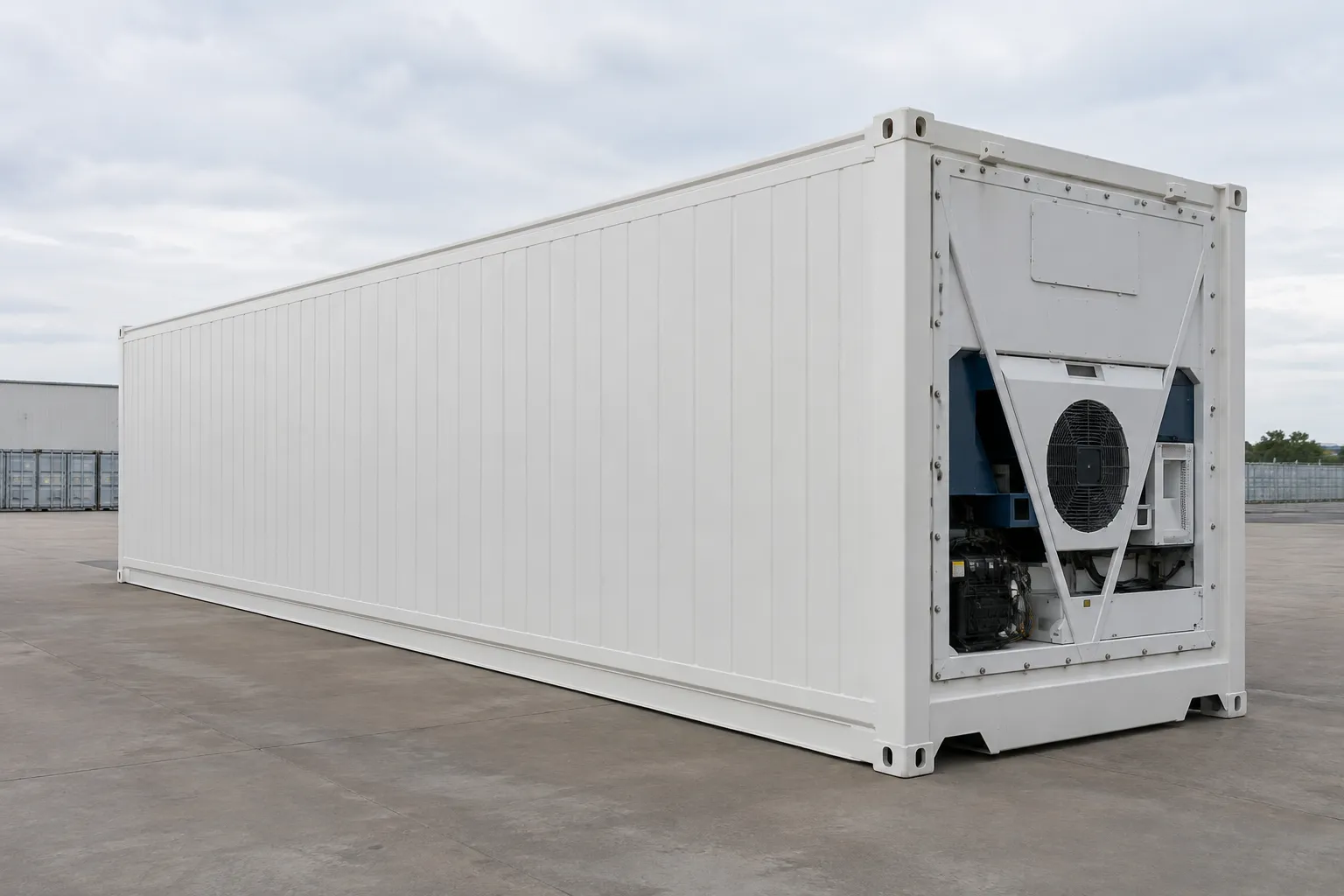
Ask for readable equipment identification and records tied to the unit identified in your written quote. Do not infer the used reefer container refrigerant type from its length, paint color or equipment brand.
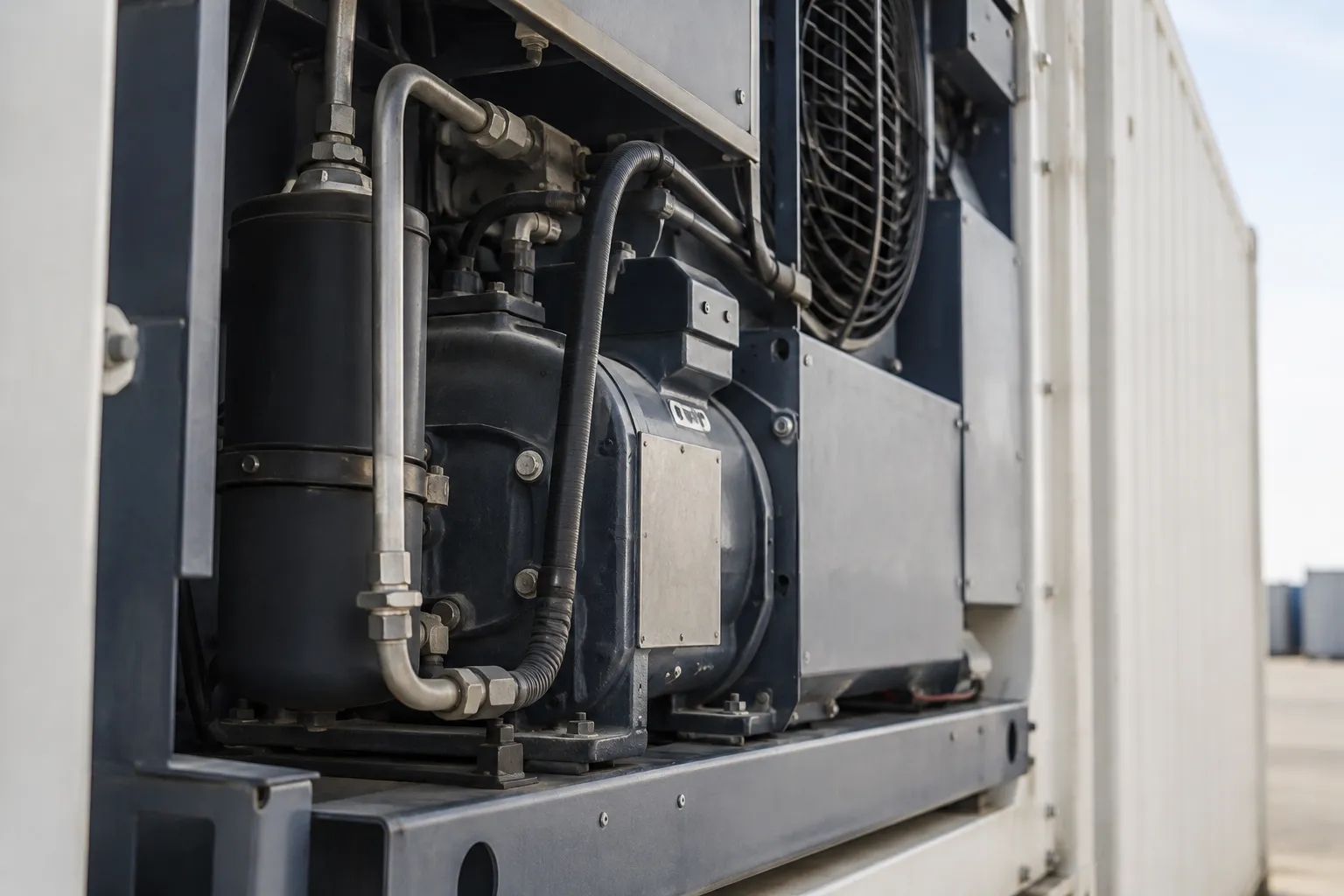
Request the following:
- Refrigeration assembly manufacturer, model and serial number.
- Equipment manufacture date, where recorded, separately from the container shell’s age.
- Original refrigerant designation and specified charge quantity.
- Any retrofit label showing the current refrigerant, charge and conversion date.
- Compressor identification and replacement history.
- Refrigerant-circuit configuration, including whether it remains fully assembled.
- Available maintenance invoices, leak-repair reports and commissioning records.
- Recent operational test results, including faults found and work completed afterward.
Equipment photos help technicians read labels and assess visible components; they do not replace written identification and specifications for the quoted unit. If the original nameplate and a later service label disagree, have a qualified technician resolve that discrepancy before purchase.
Keep shell inspection separate from equipment inspection. Our used-container inspection checklist helps organize the structural review, while refrigerated container service records explain the mechanical history.
Missing records do not prove a defect. They do create uncertainty that should affect your inspection requirements, budget or decision to proceed.
Which EPA equipment category applies to the proposed use?
“Refrigerated container” is a sales description, not a complete regulatory classification. Establish what the equipment was manufactured to do, what modifications have occurred and what you intend to do with it.
EPA’s Technology Transitions sector table distinguishes refrigeration subsectors and end uses. The applicable refrigerant restriction and compliance date depend on the relevant entry and regulated activity—not simply on whether an enclosure resembles a shipping container.
Ask a qualified refrigeration professional or compliance adviser to document:
- Whether the equipment is an intermodal refrigeration product, another transport refrigeration type or a stationary system.
- Whether the transaction involves an existing used appliance, newly manufactured equipment, an import or installation of a new system.
- Whether your proposed work is maintenance, a refrigerant retrofit or replacement that triggers different requirements.
- Which federal requirements and any applicable state or local rules govern that configuration.
Do not assume that parking an intermodal reefer permanently automatically settles its classification. Conversely, do not assume every stationary installation retains the same treatment regardless of modification.
Our 30ft refrigerated container for stationary storage and 27ft used refrigerated box body illustrate why a product’s intended role and equipment construction deserve separate review. Neither listing name alone establishes the applicable EPA category.
What the July 2027 dates cover—and why used resale is different
EPA’s sector table lists July 27, 2027 compliance dates for covered intermodal refrigeration equipment. Read those entries with their stated activity, refrigerant restrictions, definitions and footnotes. They are not a universal expiration date for every reefer already in service.
Technology Transitions requirements address specified uses of HFCs in new equipment and systems through activity-specific restrictions. Manufacture, import, sale, distribution and installation must not be treated as interchangeable terms. Verify the current entry applicable to the equipment and transaction before relying on a date in a quote.
Used resale presents a separate question. EPA’s refrigerant sales restriction questions and answers explains that used appliances containing refrigerant may be sold when the refrigerant circuit is fully assembled. That is distinct from buying refrigerant separately for servicing, which is subject to refrigerant sales restrictions.
Permission to sell an assembled used appliance is not blanket approval for any installation, conversion or future service procedure. It also does not establish that the equipment is leak-free or economical to repair.
When a seller invokes a “reefer container refrigerant phaseout,” ask which refrigerant, which rule, which equipment category and which activity they mean. Avoid both extremes: “all old reefers become illegal” and “used equipment is exempt from everything.” Neither is a reliable purchasing rule.
How to compare service history, leak repairs and refrigerant availability
Good records describe what failed, how it was repaired and what testing followed. “Recharged” by itself is weak evidence: it does not explain why refrigerant was needed or whether the underlying problem was corrected.
Use the same comparison sheet for each candidate:
| Quote item | Evidence to request | Ownership risk it reveals |
|---|---|---|
| Current refrigerant | Nameplate plus any conversion documentation | Incorrect identification or unsupported substitution |
| Charge quantity | Manufacturer specification and service record | Potential refrigerant expense during major repairs |
| Leak history | Location, repair method and follow-up test | Recurring losses or inaccessible components |
| Compressor and controls | Replacement invoices and fault history | Major component and diagnostic exposure |
| Local support | Technician confirmation for the specific model | Difficulty obtaining competent service |
| Refrigerant supply | Current supplier availability through the technician | Servicing cost and sourcing uncertainty |
Repeated additions without documented leak correction deserve investigation. So do unexplained compressor replacements, conflicting labels or a long gap between the latest repair and the latest test.
Before purchasing, send the equipment identification to a local refrigeration company. Ask whether it services that exact model, can source its refrigerant, has appropriate diagnostic tools and can obtain major replacement parts. General refrigeration experience does not necessarily mean familiarity with marine reefer controls.
Ask for separately itemized diagnostic labor, travel, refrigerant, parts and disposal charges where applicable. Used reefer repair costs are more useful as model-specific written estimates than as an unsupported national average. Availability today is helpful, but it is not a promise of future price or supply.
What a qualified technician should assess before you accept a retrofit claim
A retrofit is more than adding a different refrigerant and attaching a label. Request documentation identifying the original refrigerant, replacement refrigerant, work performed and technical basis for the conversion.
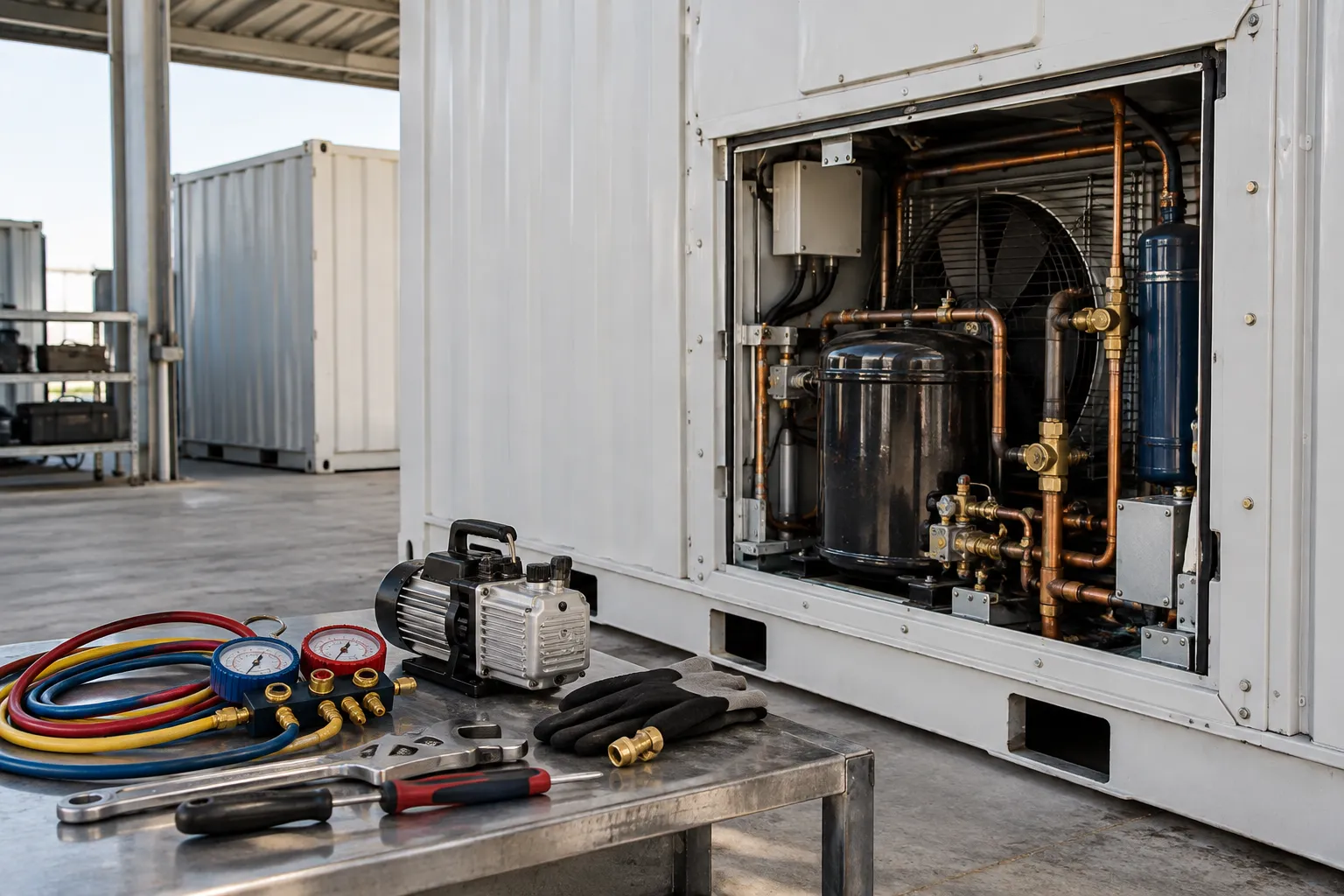
A qualified technician should assess:
- Whether the replacement is permitted for that equipment and end use.
- Manufacturer guidance for the compressor, refrigerant and lubricant combination.
- Compatibility of seals, valves, piping and other circuit components.
- Operating pressures and any required control or component changes.
- Refrigerant safety classification and implications for the proposed installation.
- Recovery, evacuation, charging and verification records from the work.
- Updated identification and service instructions for future technicians.
Lower global warming potential does not automatically mean a refrigerant is a suitable substitute. A change in flammability classification, for example, can raise equipment-design and site-safety questions that cannot be resolved by changing a service label.
Ask the reviewing technician to distinguish documented findings from assumptions. If records are unavailable, obtain an inspection scope that explains what can be established and what remains uncertain.
Refrigerated container EPA requirements should be considered alongside technical compatibility. Neither regulatory eligibility nor a brief demonstration alone proves that an undocumented conversion is a sensible purchase. Do not attempt refrigerant identification, recovery or substitution yourself.
Compare purchase price plus servicing, downtime and replacement exposure
Use a common ownership period for every quote and build a budget from identifiable costs:
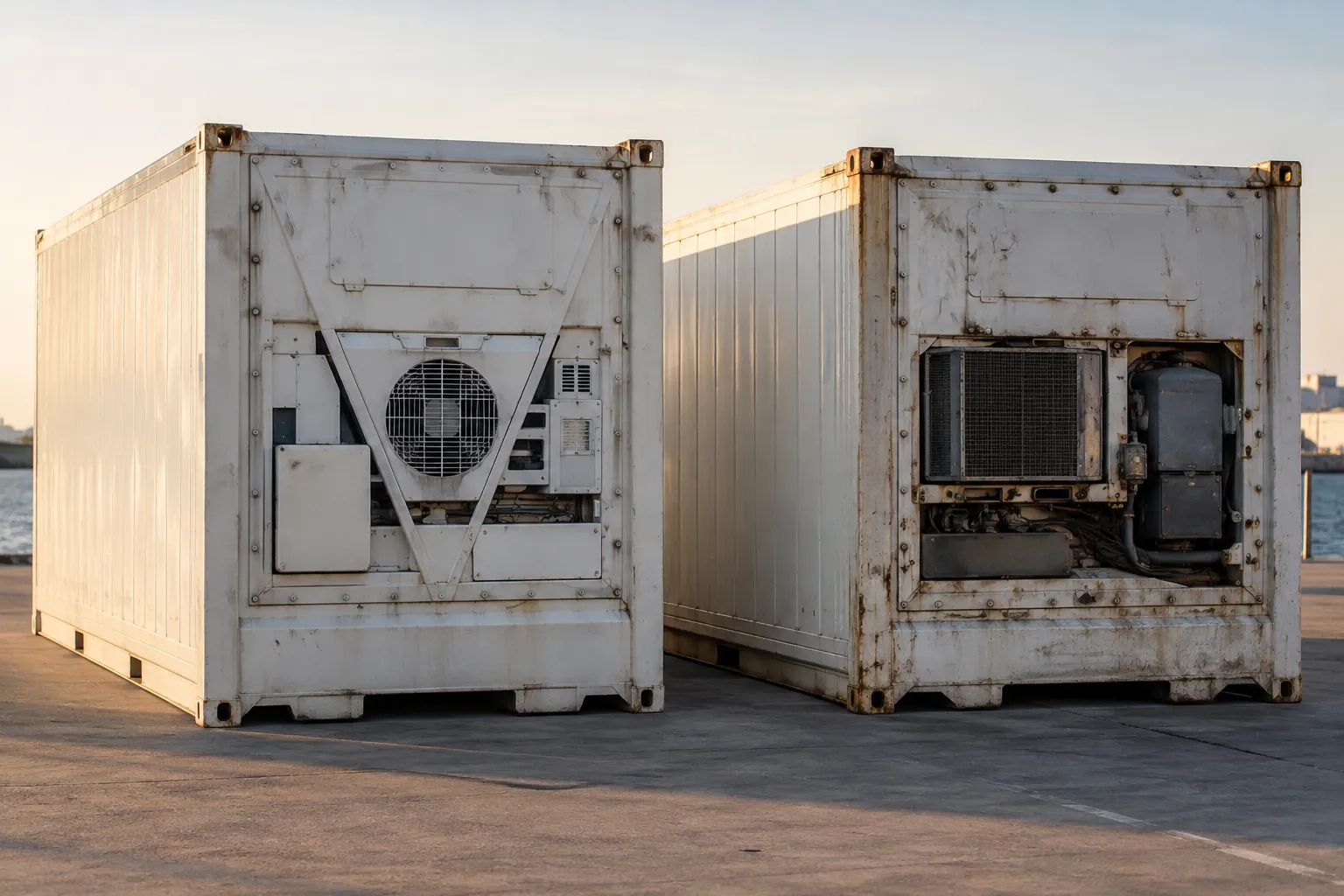
Purchase price + initial corrective work + planned servicing + repair allowance + downtime exposure + eventual replacement or decommissioning.
This is a comparison framework, not a forecast. Ask the technician for a routine-service scenario and a major-failure scenario. Keep uncertain items visible instead of assuming they cost nothing.
For starting purchase comparisons, our 20ft used reefer container is $5,550, and our 40ft high cube reefer with integrated cold storage is $6,695. These are different products, not evidence that one refrigerant system is cheaper to maintain. Request equipment documentation for each candidate.
Also distinguish an operating reefer from an insulated shell. Our 40ft non-working reefer for insulated storage is $3,100. Its non-working status should be central to your decision—not treated as a minor repair assumption. Do not budget for cooling until a technician has assessed whether restoration is practical.
If active refrigeration is unnecessary, browse specialty containers rather than inheriting machinery you do not need. If refrigeration is essential, budget for the business consequences of an outage and the logistics of replacing inaccessible equipment.
Request a documented quote for the exact refrigerated container
Turn your used refrigerated container for sale refrigerant requirements research into a written approval checklist. Ask the quote to identify the allocated container and refrigeration assembly, current refrigerant, known modifications, operating status, available records and any unresolved questions.
Your acceptance criteria should include:
- A documented equipment classification for the proposed use.
- Agreement between equipment identification and service records.
- Local technician confirmation that the model is supportable.
- A written estimate for known corrective work.
- Clear separation of structural protection from refrigeration condition and service obligations.
Lease Lane Containers units pass our manual light test before dispatch. That structural check is not a refrigerant-circuit leak test or a refrigeration commissioning report.
30-Day Structural Guarantee: if a structural defect or leak is found within 30 days of delivery, we'll provide a mobile repair, an exchange or a full refund, as set out in our Refund & Returns Policy.
Read our Refund & Returns Policy and ask for any refrigeration-specific condition commitments in writing rather than assuming structural protection covers mechanical wear.
Every unit ships from our Raleigh, NC yard and is delivered by our own trucks, trusted freight carriers or a vetted partner delivery agency, depending on your location. Standard Delivery is free on all orders delivered within the contiguous United States (Lower 48). Remote or non-standard sites and locations outside the Lower 48 are quoted in writing before you pay. Containers, homes and offices are offloaded and placed by crane.
For in-stock refrigerated containers, handling is 1–3 business days, then Standard transit is 3–7 business days, 4–10 business days in total (about a week and a half). All times start once full payment has been received and count business days only (Monday – Friday, excluding U.S. federal holidays). Our driver calls you one day before delivery to confirm the exact time. Enter your ZIP code on any product page to see your estimated arrival dates, and review our shipping policy for delivery planning.
The best used reefer is not necessarily the lowest-priced listing. It is the unit whose refrigerant, equipment history and service options you can verify. Browse the refrigerated containers above or request a documented quote before committing to a purchase.
Frequently asked questions
No. The July 27, 2027 dates in EPA’s sector table apply to covered equipment and specified regulated activities; they are not a universal retirement deadline for existing reefers. Check the relevant equipment category, refrigerant restriction and transaction type. Used resale, ongoing servicing and installation of new equipment are separate questions.
EPA’s refrigerant sales restriction guidance permits sales of used appliances containing refrigerant when the refrigerant circuit is fully assembled. That does not establish compliance with every other applicable requirement or prove mechanical condition. Confirm the circuit’s status, equipment identification and proposed use, and arrange qualified servicing rather than assuming appliance ownership allows unrestricted refrigerant purchases.
Start with the refrigeration assembly nameplate, then check for retrofit labels and service records. Record the model, serial number, refrigerant designation and charge quantity. If labels conflict or records suggest a conversion, have a qualified technician investigate. Do not identify refrigerant solely from the container’s age, size or equipment brand.
No. A lower-GWP refrigerant still needs to be permitted for the equipment and end use and technically compatible with the system. A qualified technician should review manufacturer guidance, lubricant compatibility, component changes, operating pressures and safety classification. Ask for conversion and verification records before treating a retrofit claim as added value.
Recurring leaks, unsupported controls, difficult-to-source components, unclear conversions and limited local technician support can erase purchase savings. Ask for model-specific estimates covering routine servicing and a major failure. Include downtime and eventual replacement in the comparison. A non-working reefer should be evaluated as insulated storage unless restoration has been assessed and budgeted.
Sources & further reading
- US EPA — Technology Transitions HFC Restrictions by Sector
- US EPA — Questions and Answers about the Refrigerant Sales Restriction
- Freddie Mac — Single-Family Seller/Servicer Guide, Section 5605.5: Improvements Analysis
- Federal Reserve Bank of Atlanta — Home Ownership Affordability Monitor, August 2026
- International Code Council — 2024 International Fire Code, Chapter 3: General Requirements
- Associated Press — Can larger batteries safely power residential buildings? A project in New York aims to show how
Talk to our Raleigh team
Ready to find the right container?
Get a written quote, check availability or ask about delivery to your site. Lease Lane Containers LLC answers every enquiry personally.
- Call us+1 (984) 219-9882
- Emailsales@leaselanecontainers.llc
- Visit5832 Lease Ln, Ste B, Raleigh, NC 27617
- Business hoursMon - Fri: 9:00 AM - 5:00 PM · Sat - Sun: Closed (ET)