Pools, Cafés & Lifestyle Projects
20ft Shipping Container Coffee Shop for Sale: Quote Checklist
A coffee kiosk quote should define more than the container. Match the fit-out to your drinks menu, equipment, utility connections, and local opening requirements before you buy.
9 min readBy the Lease Lane Containers team
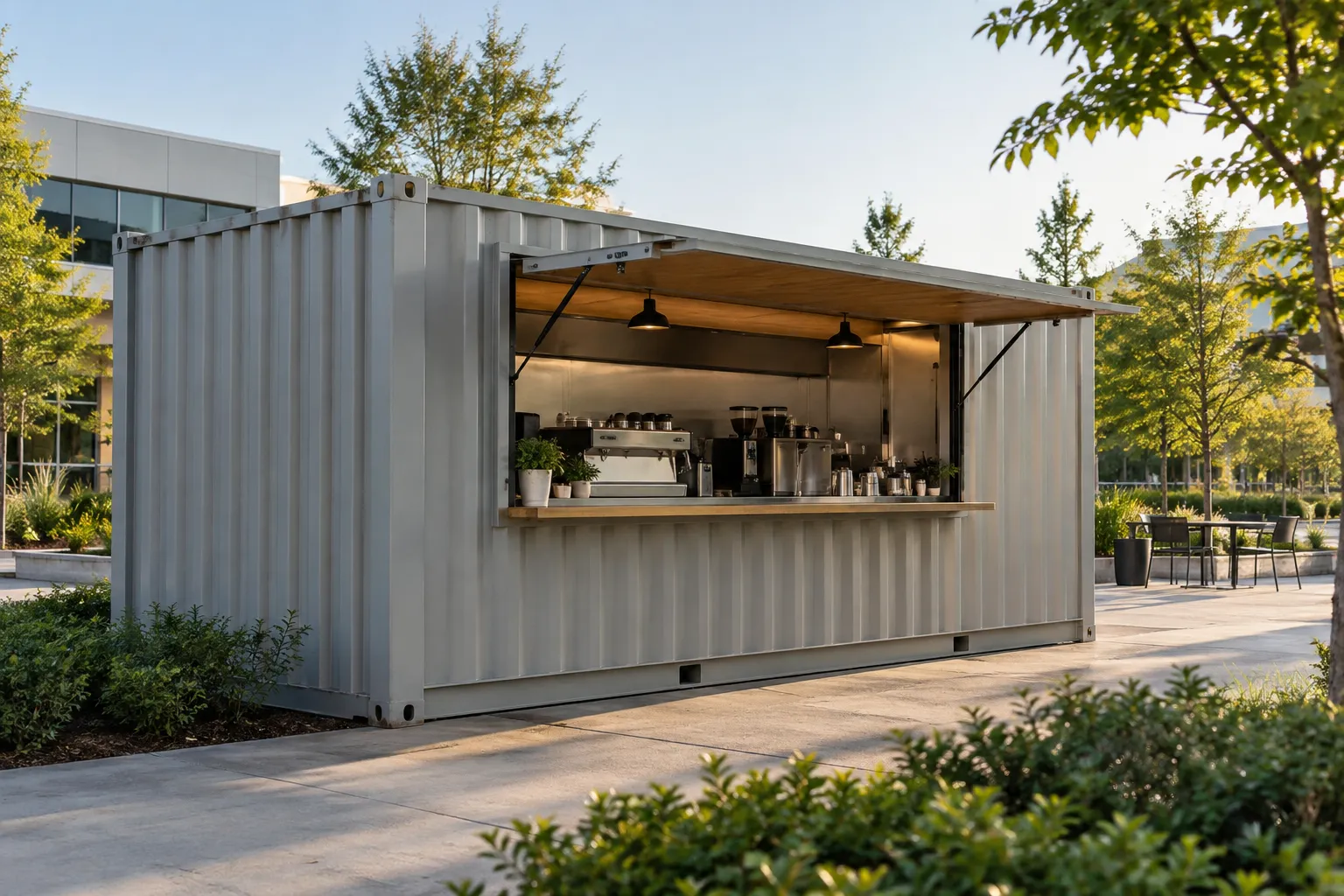
If you’re comparing a 20ft shipping container coffee shop for sale, the quote should include a dimensioned layout, itemized container fit-out, equipment schedule, utility connection details, exclusions, delivery scope, and acceptance criteria. It should also identify who handles site work and approvals. A serving hatch and attractive interior do not establish that a kiosk is ready to open.
For a beverage-only business, buy against your actual operating plan: what you serve, how staff prepare it, and what your local reviewers require. Keep the container purchase separate from the equipment package and the work needed at your site.
What Are You Buying: An Empty Shell, Fitted Kiosk or Equipped Coffee Shop?
These descriptions are useful only when the quote defines them:
- Empty shell: the container structure, with only specifically listed modifications included.
- Fitted kiosk: a defined package of openings, insulation, finishes, counters, and building services. Equipment may be excluded.
- Equipped coffee shop: a fitted kiosk plus named equipment models, installation, and specified testing. Site connections and operating approvals may still be excluded.
Start with our 20ft Custom Container Café, listed at $7,050, and 20ft Custom Container Kiosk with serving hatch and insulated interior, listed at $10,200. Their names describe different starting points—not identical inclusions or a complete container cafe equipment package.
Compare them within our food and beverage containers. Ask for a written scope rather than assuming photographed espresso machines, sinks, or furnishings are included.
A shell-first project might instead begin with the 20ft new one-trip container. Check our container grades guide when evaluating shell condition. Neither a new shell nor a converted unit automatically establishes food-service suitability.
Define the Menu Before Comparing Container Quotes
Write a one-page menu brief before requesting fabrication. Espresso, brewed coffee, tea, iced drinks, and blended beverages create different requirements even without cooking.
The National Coffee Association’s September 2026 newsroom release is not a container-demand measure. Its report of out-of-home consumption reaching its highest level since January 2020 among past-day coffee drinkers is a broader café-market signal; see the NCA newsroom. It does not prove demand at your proposed location.
Translate your menu into operating assumptions:
- Espresso and milk drinks: machine capacity, grinders, refrigerated milk storage, pitcher rinsing, and cleaning arrangements.
- Iced drinks: ice production or approved purchased-ice storage, scoop storage, filtration, and drainage.
- Blended beverages: blender space, noise, ingredient storage, and utensil washing.
- Brewed coffee and tea: brewer dimensions, hot-water demand, and safe dispensing space.
- Cold brew: purchased product versus on-site preparation, refrigeration, and the process your health reviewer accepts.
State expected busy-period orders, staffing, cup sizes, and replenishment frequency as planning assumptions—not promised sales. Specify whether drinks use disposable cups and whether reusable pitchers and tools are washed on site. “Beverages only” does not mean “no sanitation infrastructure.”
Will a 20ft Layout Fit Your Equipment and Barista Workflow?
A standard 20ft container has a nominal exterior footprint of approximately 160 square feet. Usable interior space is smaller and decreases with insulation, lining, partitions, and service chases. Require finished internal dimensions rather than designing from the exterior footprint.
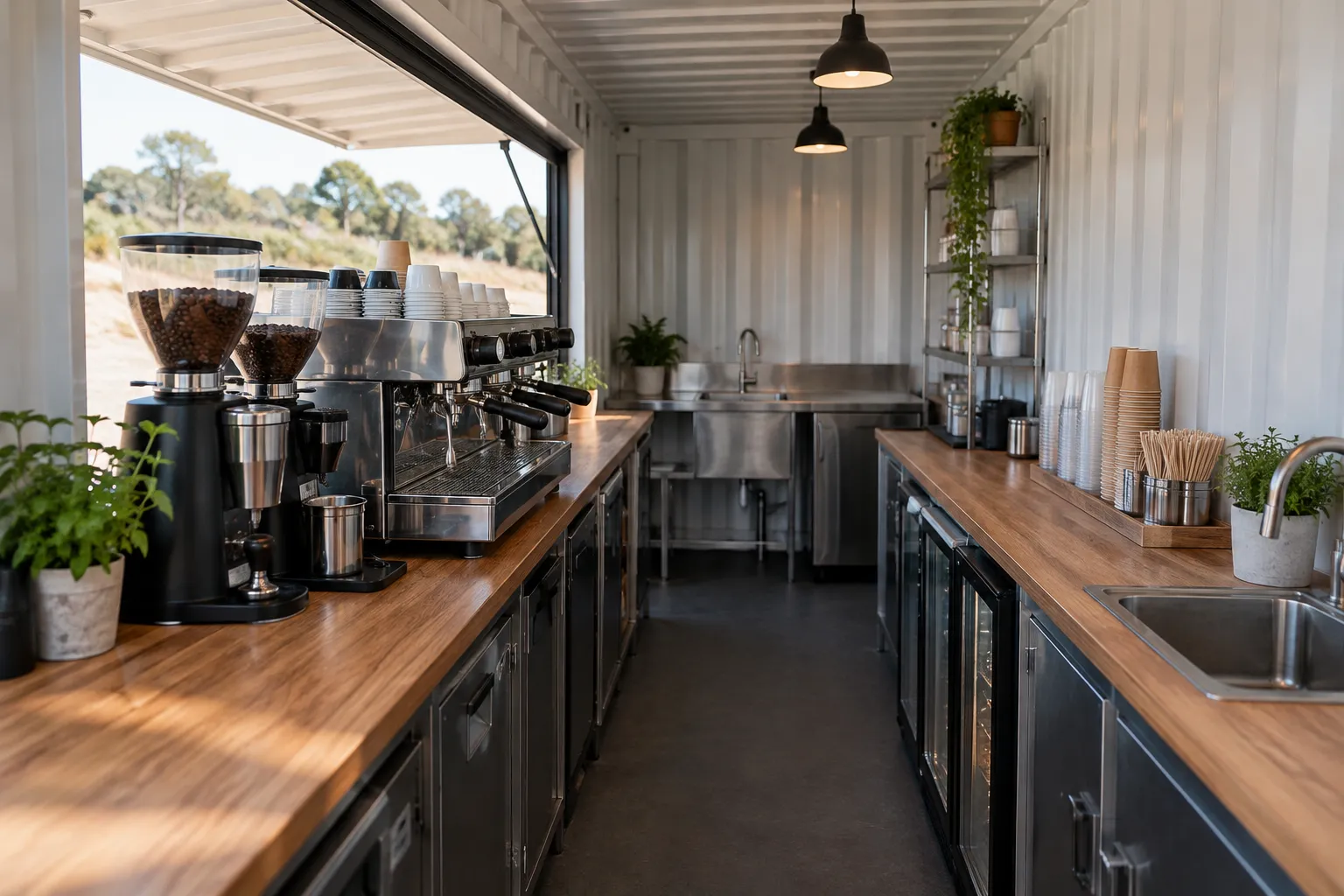
Place equipment at its actual size, including handles, open doors, ventilation clearances, and service access. An undercounter refrigerator that fits beneath a counter can still block the working aisle when opened.
A sensible sequence is order taking, cup preparation, grinding and extraction, milk or ice handling, then pickup. Keep dirty utensils and waste from repeatedly crossing that path. Test the drawing with two staff roles: one preparing drinks and one taking orders or restocking.
Ask the designer to show:
- Counter depth and working height, with space for machine servicing.
- Clear aisles, door swings, exits, and access to the handwashing sink.
- Refrigeration, ice, cups, lids, cleaning supplies, and daily stock.
- Water heater, filtration cartridges, HVAC equipment, and maintenance access.
The 20ft high-cube one-trip container offers extra height, but not extra width. Compare options in our 20ft container range using finished drawings. Before approving a prefab container coffee shop, tape the proposed counters and appliances onto a floor and rehearse ordinary tasks.
Specify the Serving Window, Order Point and Customer Queue
Write down the hatch’s clear opening, counter projection, opening mechanism, locks, seals, and structural reinforcement. Ask how the open hatch sheds rain and how staff close it safely. Any canopy, exterior counter, or customer shelter should be a separate line item unless expressly included.
Our 20ft high-cube container bar with multiple serving hatches is another configuration to evaluate. Multiple hatches may separate ordering from pickup, but that benefit depends on internal workflow and the available customer area.
Confirm the accessible route and service-counter arrangement with your project designer. Show the customer queue without obstructing exits, neighboring businesses, or vehicle movements.
A shipping container drive thru coffee stand needs a site circulation plan, not simply a window facing pavement. Check vehicle stacking, turning paths, pedestrian separation, order-point communication, and protection around the kiosk. Treat drive-through approval and traffic work as site responsibilities unless your quote explicitly includes them.
Check Electrical Loads, Water Supply, Drainage and Water Heating
“Power and plumbing included” is not a useful specification. The quote needs a coordinated equipment schedule and defined connection points.
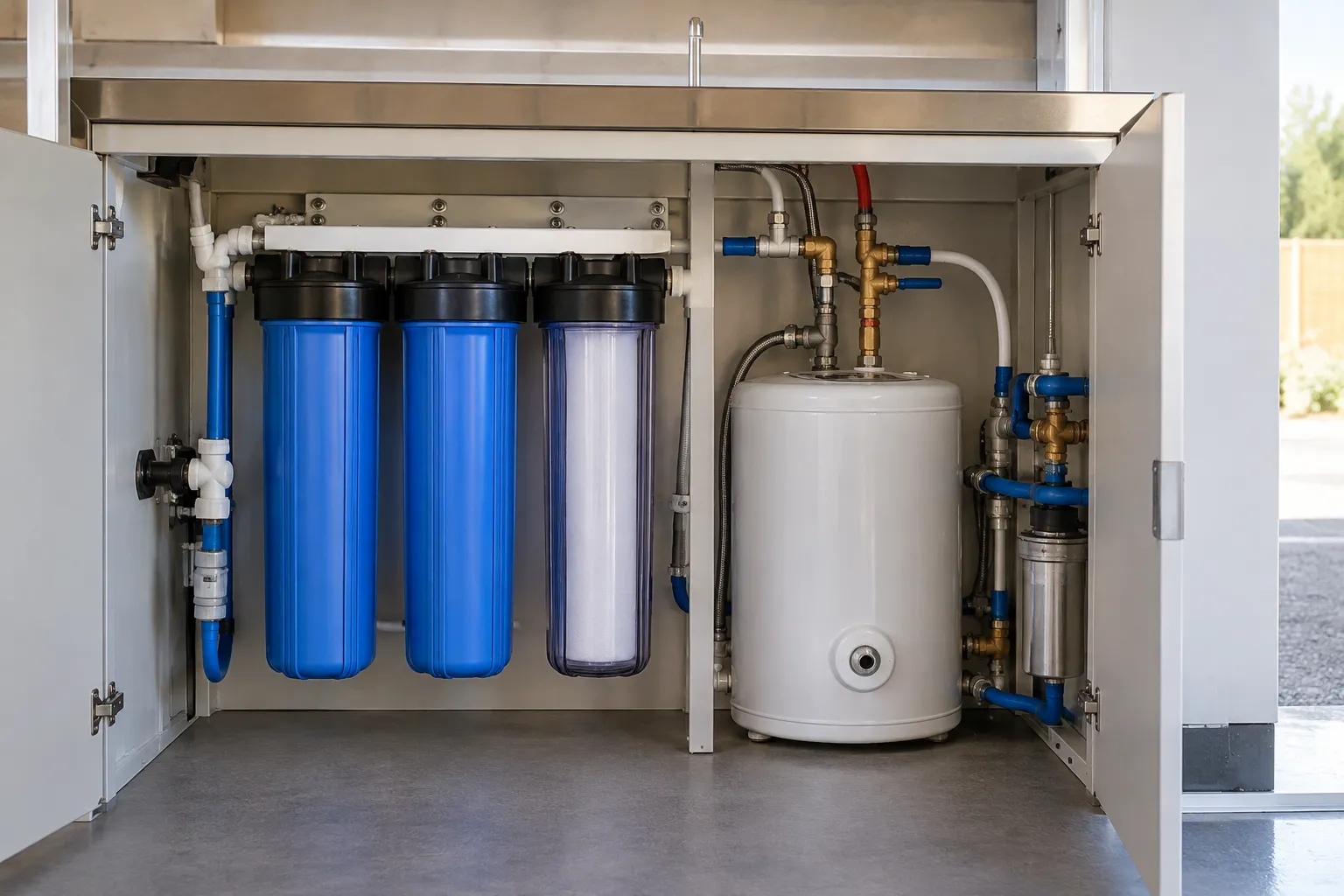
Electrical service and equipment loads
For every appliance, record the manufacturer, model, dimensions, voltage, phase, rated load, connection type, and required circuit. Include the espresso machine, grinders, brewer, refrigerator, ice machine, blender, water heater, HVAC, lighting, and point-of-sale equipment.
Have a qualified electrical professional calculate the service requirement and confirm that the site can supply it. A fitted panel does not establish that the utility connection has sufficient capacity. Identify responsibility for service upgrades, trenching, disconnects, grounding, inspections, and final hookup.
Water, drains, and hot water
Container coffee shop plumbing requirements depend on the menu, equipment, and locally accepted design. Request a drawing showing potable-water entry, shutoffs, filtration, backflow protection where required, hot-water distribution, drain outlets, and service access.
Ask the plumbing designer to specify:
- Machine water pressure, flow, and manufacturer-recommended water treatment.
- Handwashing and warewashing fixtures accepted for your operation.
- Indirect waste connections or air gaps where required.
- Water-heater capacity and recovery based on simultaneous demand.
- Drain routing, freeze protection, and access for cleaning or repairs.
Tank-based operation needs explicit local acceptance, appropriate potable-water components, and an approved wastewater disposal arrangement. Never assume a storm drain is a suitable wastewater connection.
Also specify insulation, condensation management, and HVAC capacity for equipment heat and frequent hatch opening. A beverage kiosk still needs a comfortable, maintainable working environment.
Confirm Local Health-Department Requirements Before Fabrication
The FDA Food Code is a model for retail food regulation, not a nationwide operating permit. Publication or discussion of a newer edition does not mean your jurisdiction has adopted it. Confirm the locally adopted edition and amendments with the reviewing authority.
Submit the menu, equipment cut sheets, dimensioned layout, finish schedule, and water-and-waste proposal before irreversible modifications. Ask reviewers to clarify:
- Whether the business is classified as fixed, mobile, temporary, or another establishment type.
- Handwashing, utensil-washing, and cleaning-facility requirements.
- Acceptable equipment sanitation certifications and cleanable surfaces.
- Refrigeration, ice handling, employee restroom access, and any commissary requirement.
- Whether the beverage processes trigger additional review.
Health review is separate from zoning, building, electrical, plumbing, accessibility, and fire review. A beverage-only menu may avoid some cooking-related systems, but do not assume an exemption from ventilation or other requirements.
Define an approval hold point in the purchasing process: which drawings require review, who submits them, and how requested changes are priced. Our container buying guide helps organize the broader purchase, but local authorities determine your opening requirements.
Compare Total Opening Costs: Container, Equipment, Site Work and Approvals
For a 20ft shipping container coffee shop for sale, compare the same scope across every proposal. Shipping container coffee kiosk cost is not just the listed container price.
| Cost group | What the quote or project budget should identify |
|---|---|
| Container and fit-out | Shell, reinforcement, hatch, doors, finishes, counters, insulation, and building systems |
| Beverage equipment | Named models, quantities, installation, filtration, startup, and exclusions |
| Site work | Foundations or supports, anchoring, drainage, access, paving, and utility runs |
| Professional work and approvals | Drawings, engineering, applications, inspections, and responsible parties |
| Opening essentials | Smallwares, initial stock, cleaning supplies, staff training, and commissioning |
| Delivery interface | Access review, crane placement conditions, and any non-standard site charges |
For example, the custom café’s listed price is $7,050; the custom kiosk’s is $10,200. Their price difference does not reveal which has the lower opening cost. Compare written inclusions, then add every excluded item once.
Sales tax is included and paid by Lease Lane Containers, so nothing is added at checkout.
Our delivered container cost guide explains purchase-cost comparisons. For placement preparation, use the delivery site checklist alongside your commercial site plan.
Delivery is not an opening date
Every unit ships from our Raleigh, NC yard and is delivered by our own trucks, trusted freight carriers or a vetted partner delivery agency, depending on your location.
Standard Delivery is free on all orders delivered within the contiguous United States (Lower 48). Expedited Delivery (optional) costs $450 per unit for in-stock products (Expedited isn't offered on accessories). Containers, homes and offices are offloaded and placed by crane. Remote or non-standard sites and locations outside the Lower 48 are quoted in writing before you pay.
For in-stock products other than container homes, handling is 1–3 business days. Standard transit is 3–7 business days, 4–10 business days in total (about a week and a half). Expedited transit is 2–5 business days, 3–8 business days in total. All times start once full payment has been received and count business days only (Monday – Friday, excluding U.S. federal holidays).
Enter your ZIP code on any product page to see your estimated arrival dates. Our driver calls you one day before delivery to confirm the exact time. Review our shipping policy and distinguish the listed in-stock configuration from requested fabrication changes. Do not treat transport estimates as a promise of business-opening readiness.
Request an Itemized Quote With Drawings, Exclusions and Acceptance Criteria
Send each supplier the same menu, site information, and equipment schedule. Require the proposal to return these six deliverables:
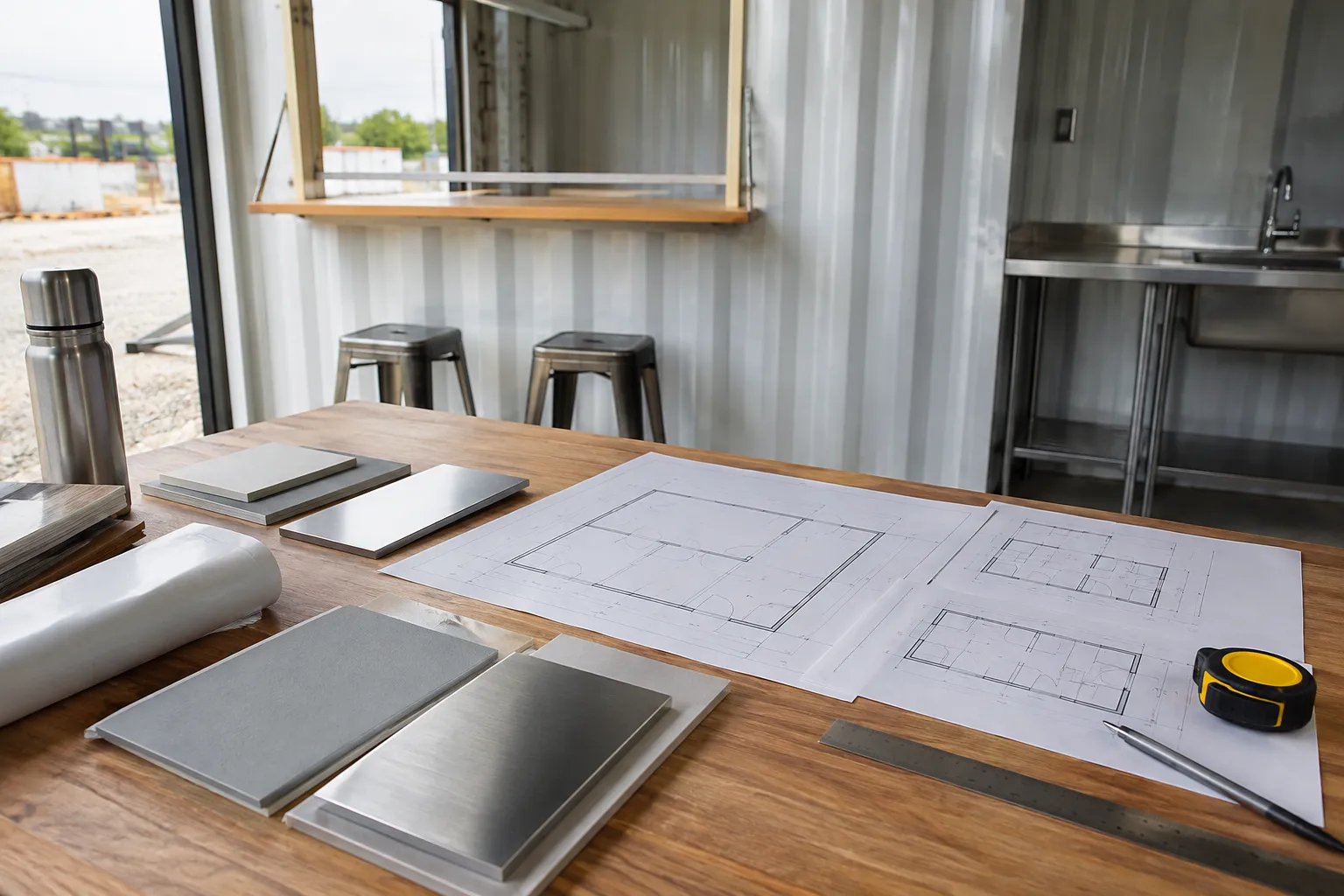
- Revision-controlled drawings: finished dimensions, elevations, equipment positions, openings, reinforcement, and connection locations.
- Itemized inclusions: materials, quantities, equipment models, finishes, and installation responsibilities.
- Explicit exclusions: site utilities, foundations, approvals, appliances, smallwares, and commissioning not included.
- Responsibility schedule: who designs, supplies, installs, tests, and obtains each approval.
- Change procedure: written authorization for substitutions or scope changes and their cost implications.
- Acceptance checklist: measurements, door and hatch operation, finish inspection, specified electrical and plumbing tests, and documentation supplied.
Separate pre-dispatch checks from tests that require connected site utilities. Ask who resolves each outstanding item and what evidence closes it.
Units pass our manual light test before dispatch. 30-Day Structural Guarantee: if a structural defect or leak is found within 30 days of delivery, we'll provide a mobile repair, an exchange or a full refund, as set out in our Refund & Returns Policy.
Read the Refund & Returns Policy before ordering. Structural coverage does not replace equipment commissioning or local operating approval.
When choosing a 20ft shipping container coffee shop for sale, prioritize a quote you can measure against your menu and opening checklist. Browse our modified containers or request an itemized quote with your equipment schedule and site requirements.
What "fully furnished" means: when one of our container homes is described as fully furnished, it means built-in amenities only: interior finishes and any built-in cabinetry, kitchen or bathroom fit-out, electrical and plumbing that are listed in this home's specifications. Loose furniture and appliances (for example beds, sofas, tables, refrigerators and microwaves) are not included unless listed in your written quote.
Frequently asked questions
Our 20ft Custom Container Café is listed at $7,050, and our 20ft Custom Container Kiosk is listed at $10,200. These are product prices, not complete opening budgets. Compare the specified fit-out, then account for excluded beverage equipment, site utility connections, foundations, professional drawings, approvals, and commissioning.
Only assume an espresso machine is included when your written quote names its model, quantity, and installation scope. The same applies to grinders, refrigeration, ice machines, filtration, and smallwares. A fitted kiosk may include counters and building services without beverage equipment. Ask whether equipment startup and testing are included or assigned to another contractor.
It can be suitable for a focused beverage menu, but staffing capacity depends on the finished layout rather than nominal container length. Check actual appliance dimensions, open refrigerator doors, sink access, storage, and clear working aisles. Rehearse drink preparation and restocking with a taped floor layout before approving drawings, and have required clearances verified.
Expect the reviewer to assess handwashing, reusable utensil cleaning, potable water, hot water, and wastewater disposal even without cooking. The exact fixtures and arrangements depend on your menu and locally adopted rules. Submit the equipment list and operating process to the health department before fabrication; disposable customer cups do not eliminate the need to clean reusable preparation tools.
Potentially, if the site and business use are approved. A serving window alone does not create a workable drive-through. Your site plan should address vehicle stacking, turning paths, pedestrian separation, window access, and protective barriers where needed. Confirm zoning and traffic requirements before purchasing, and distinguish container modifications from pavement and other site work.
Sources & further reading
- National Coffee Association Newsroom — September 15, 2026: Coffee Tops Beverage Charts Again, Specialty Coffee Hits New High
- FDA Food Code — 2026 Edition and October 8, 2026 Adoption Discussion
- ACSM: Wearables Hold Top Spot in ACSM’s 2027 Fitness Trends — October 20, 2026
- OSHA: 29 CFR 1926.51 — Sanitation
- U.S. Census Bureau: Monthly Construction Spending, August 2026 — Released October 1, 2026
Talk to our Raleigh team
Ready to find the right container?
Get a written quote, check availability or ask about delivery to your site. Lease Lane Containers LLC answers every enquiry personally.
- Call us+1 (984) 219-9882
- Emailsales@leaselanecontainers.llc
- Visit5832 Lease Ln, Ste B, Raleigh, NC 27617
- Business hoursMon - Fri: 9:00 AM - 5:00 PM · Sat - Sun: Closed (ET)