Sizes, Dimensions & Specifications
Buy Shipping Container for Car Storage: Fit and Exit Checklist
A car can fit through the container doors yet leave its driver trapped inside. Measure the vehicle, test your exit space, and confirm actual-unit dimensions before buying.
9 min readBy the Lease Lane Containers team
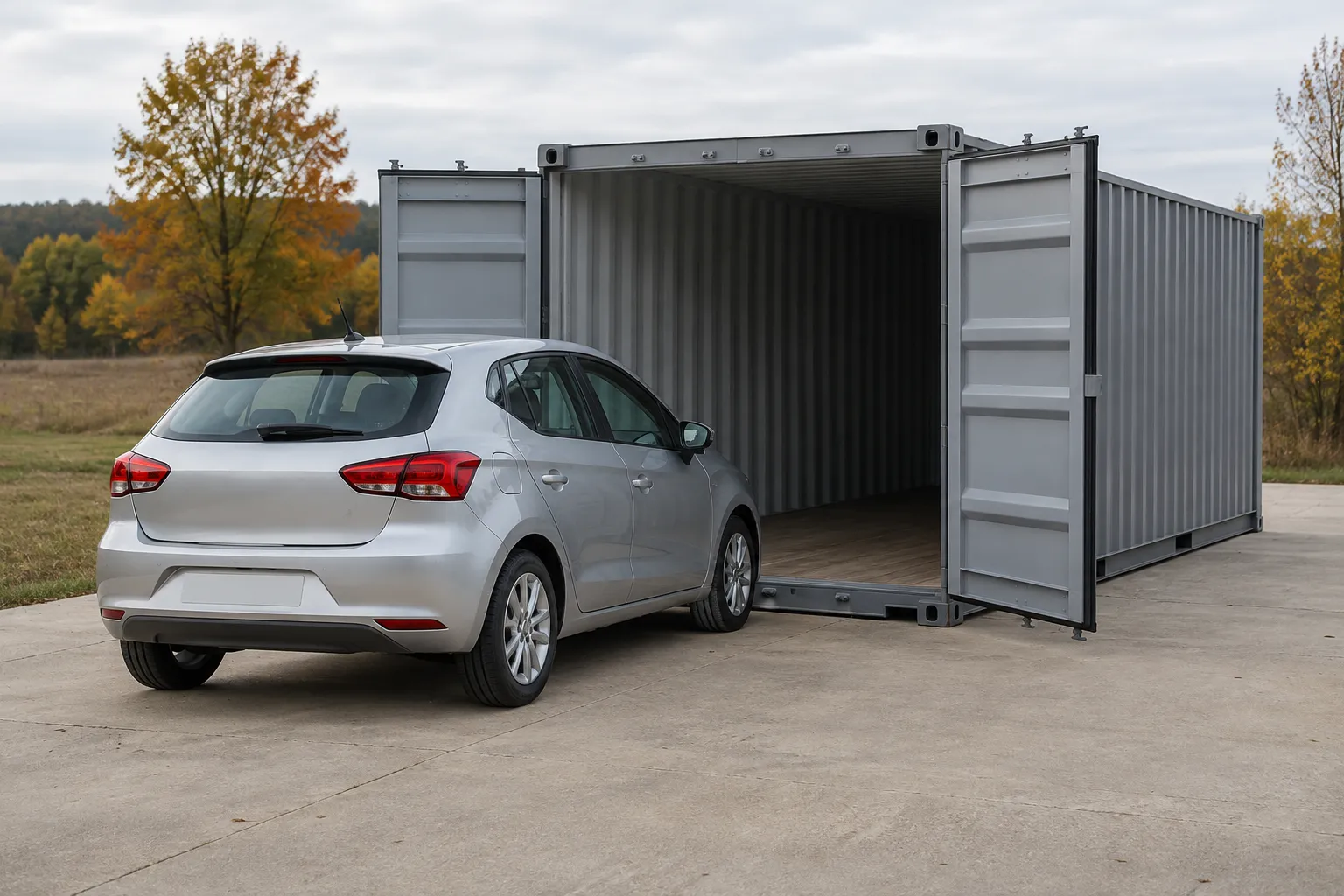
A shipping container can work for car storage—but only if your vehicle clears the opening, fits inside with usable space, and lets you exit safely. Before you buy shipping container for car storage, check all three separately. A car that squeezes through the doors is not automatically a practical storage fit.
The deciding measurements are mirror width, driver-door swing, usable interior length, and clearance over the loading ramp. Nominal descriptions such as “20ft” or “40ft” cannot answer those questions. Require measurements of the actual unit quoted before committing to a purchase.
Before you buy shipping container for car storage: measurement worksheet
Measure your vehicle on level ground in its normal storage configuration. Include roof racks, spoilers, tow hitches, running boards, and other fitted equipment. Use one measurement system throughout; record inches or millimeters rather than mixing rounded figures.
Complete this worksheet before requesting a quote. Leave the container column blank until the seller confirms the actual unit.
| Check | Vehicle measurement to record | Actual-unit or site measurement required |
|---|---|---|
| Entry width | Widest point with mirrors extended and folded | Narrowest clear door opening, including hardware |
| Parked width | Body width and projections at door height | Minimum interior width along the parking position |
| Driver exit | Space needed beside the body to open the door and step out | Available driver-side clearance and unobstructed walking route |
| Height | Highest fitted point | Clear opening height and minimum interior height |
| Length | Overall length including permanent attachments | Clear length with cargo doors closed |
| Front and rear access | Space needed to walk, inspect, or open a hatch | Remaining space beyond both bumpers |
| Ramp geometry | Wheelbase, overhangs, and lowest underbody points | Installed threshold rise, ramp run, and transition shape |
| Loading capacity | Operating vehicle weight and axle loads | Floor condition, wheel-load suitability, and ramp ratings |
| Outdoor access | Turning and straight-line approach needs | Available approach, ramp footprint, and door-swing area |
Photograph your measurements and note how you took them. Manufacturer specifications are a useful starting point, but a published width may exclude mirrors. Modified suspension and aftermarket bodywork can also change the result.
Our container buying guide covers the broader purchase process. For vehicle storage, treat the completed worksheet as an attachment to your quote request, not an optional follow-up.
Door opening versus interior space: what must the seller confirm?
The doorway is a separate restriction from the interior. Hapag-Lloyd’s example 20ft standard container specifications list a door opening width of 2,340 mm and an internal width of 2,352 mm—approximately 92.1 and 92.6 inches respectively. That 12 mm difference illustrates why internal width alone cannot establish entry clearance.
Those are reference dimensions, not measurements of a Lease Lane Containers unit. Manufacturing differences, repairs, door hardware, and modifications can change usable space.
Ask the seller to confirm:
- Clear doorway width at the narrowest point with both doors secured open.
- Clear opening height from the threshold to the lowest obstruction.
- Interior width at mirror, body, and open-door heights.
- Usable length with the cargo doors shut and locking hardware unobstructed.
- Any inward dents, shelving, lining, raised flooring, or other projections.
- Floor condition and suitability for the vehicle’s concentrated wheel loads.
For illustration, a vehicle measuring 2,100 mm across its mirrors has 240 mm total clearance through a 2,340 mm opening. Centered perfectly, that is 120 mm per side—not an allowance for steering error, uneven approach, or mirror movement.
Do not select a universal minimum clearance from that example. Agree on a practical margin for your vehicle and loading method. Our container grades guide explains condition terminology, while the used-container inspection checklist helps organize condition questions.
Can you open the driver's door and exit safely?
Passing through the opening and getting out are different tests. Shipping container car door clearance often becomes the purchase-blocking issue, especially with long coupe doors, wide SUVs, or drivers who need more movement space.
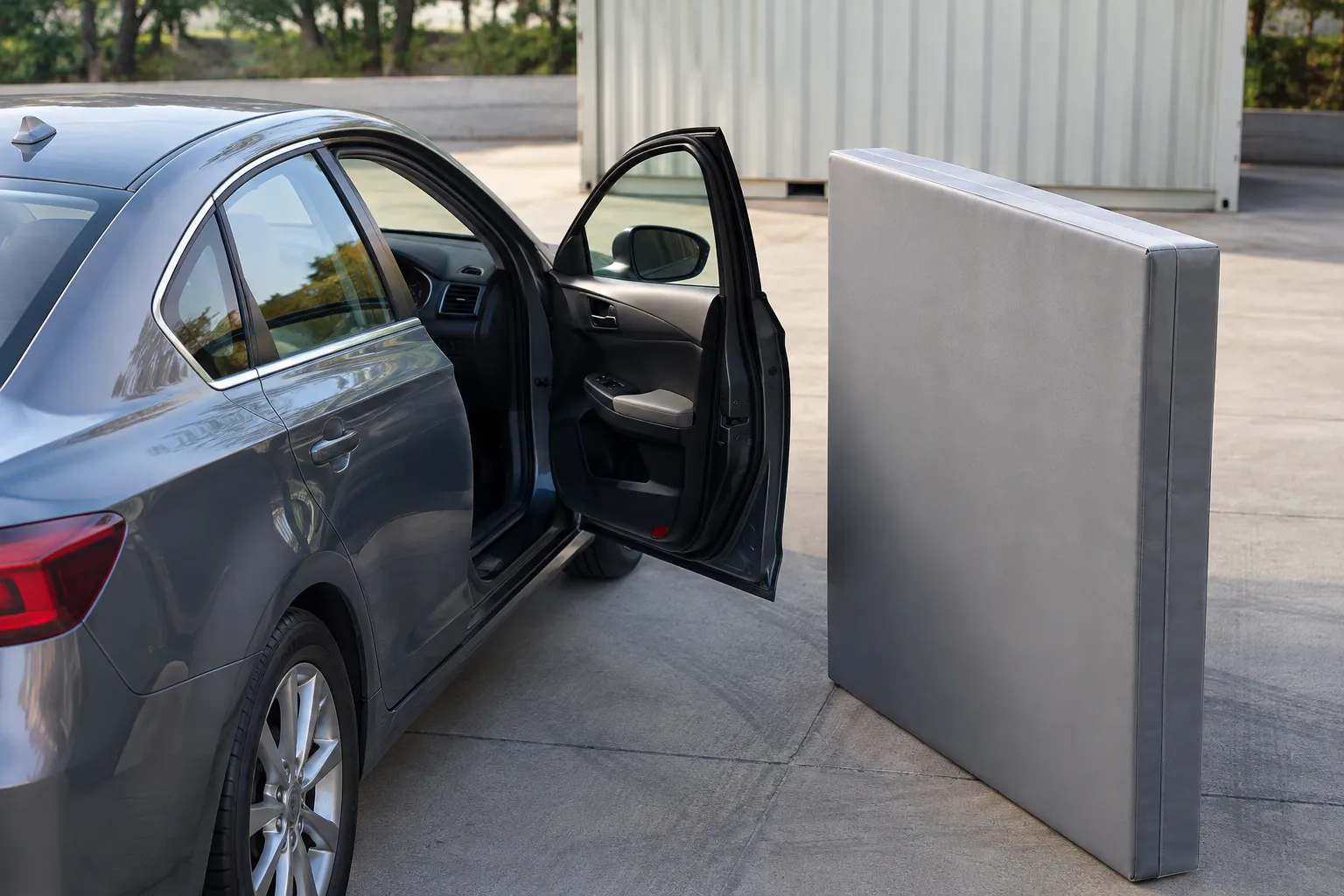
Use a stationary mock-up before buying:
- Park on level ground with the engine off and parking brake applied.
- Mark the proposed interior width on the ground beside the vehicle.
- Use soft, movable markers to represent the wall at door height; do not rely only on a floor line.
- Open the driver’s door to the position needed for a normal exit.
- Step out and back in without twisting awkwardly or touching the simulated wall.
- Check the route from the driver’s door to the container exit.
The width budget is straightforward: interior width must accommodate vehicle body width, passenger-side clearance, and the driver’s measured exit space. Account separately for mirrors or other projections that extend beyond the body.
Parking off-center may help, but it does not remove the need for clearance on the opposite side. You must also reach that position safely through the doorway.
Test with the actual driver, including any mobility needs and normal winter clothing. Do not base the purchase on climbing through a window, trunk, or passenger compartment. Keep the container doors secured open while occupied, and never allow someone to close or lock them with a person inside.
If normal exit fails, investigate correctly positioned side access or choose a wider storage building. Additional container length alone will not fix the problem.
20ft versus 40ft: choose usable length, not just nominal size
For 20ft shipping container car storage, calculate the full parking envelope:
Required usable length = vehicle length + planned front clearance + planned rear clearance.
For example, a 15ft vehicle with 2ft planned at each end requires 19ft of clear interior length. Those allowances are a planning example, not a universal recommendation. If you need to open a hatch, inspect a battery, or walk around a bumper, measure that activity directly.
Start with our 20ft container selection when the worksheet indicates enough room. The 20ft used shipping container and 20ft new one-trip shipping container are candidates to compare—not automatic fit approvals.
Move to the 40ft container selection when a longer vehicle, equipment, or front-and-rear access needs more space. A 40ft standard-height used storage container provides a longer layout, but do not assume it provides more driver-door width.
Double-end access can improve access to equipment beyond the vehicle. The 40ft tunnel shipping container is worth evaluating for that layout. It does not solve restricted side clearance, and drive-through use requires suitable approaches and ramps at both ends.
If considering two vehicles, add both overall lengths, separation space, and end access. Do not infer two-car suitability from the “40ft” label.
Standard end doors versus open-side access
Standard end doors offer a straightforward loading route when the car and driver-exit envelope both fit. An open side container for car storage addresses a different issue: access beside the parked vehicle.
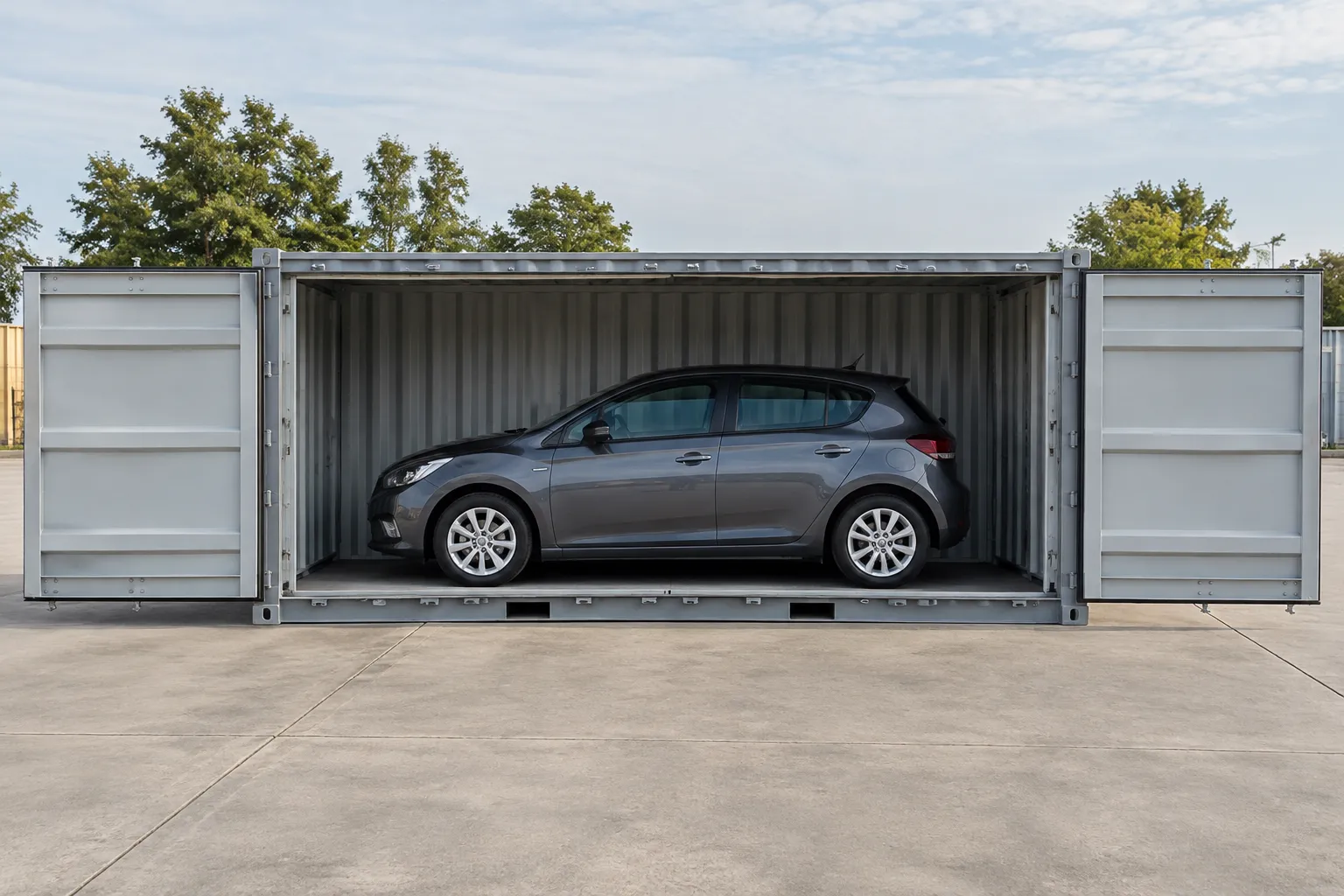
Compare our open-side containers when side access could align with the driver’s door. The 20ft one-trip full-length side-access container is one configuration to investigate.
Before choosing it, confirm:
- The exact clear side opening and any fixed posts or obstructions.
- Where the driver’s door will sit relative to that opening.
- The height of the side sill and the safe step-down route.
- Exterior clearance for container door leaves and the car door.
- Whether the side doors can be operated safely with the car parked.
Side access does not automatically mean the vehicle can drive in sideways. It also does not create extra enclosed width once the side doors are shut. A fence, retaining wall, or neighboring structure can make the feature unusable.
When comparing a shipping container garage for sale, ask for an opening layout with dimensions. “Side door” may describe a small access door rather than the full-length opening your exit plan requires.
Ramp capacity, approach angle, and underbody clearance
A shipping container vehicle loading ramp must match both the vehicle and the installed container. A generic ramp description is not proof of automotive suitability.
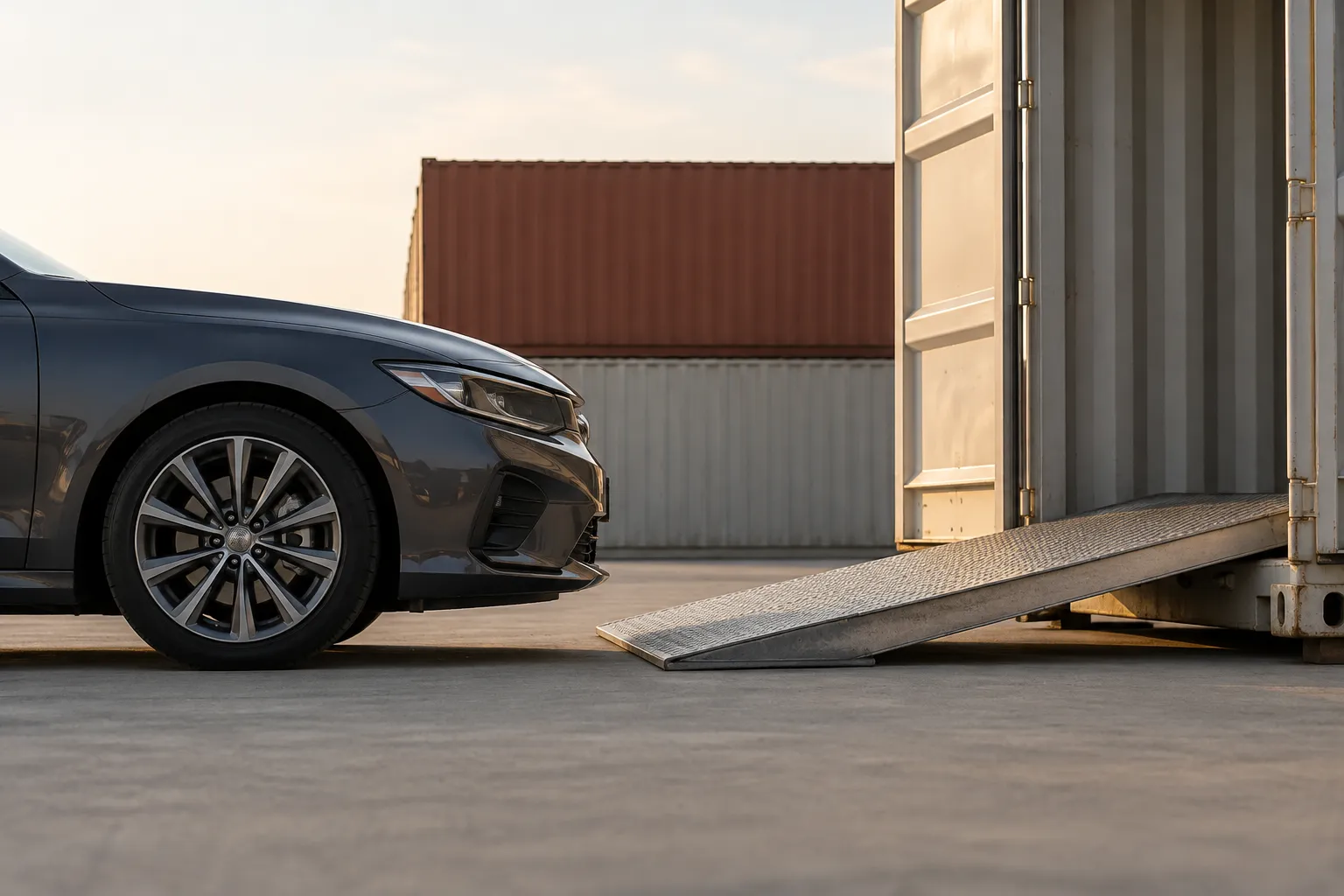
Our removable steel container loading ramp is an accessory to assess only after its specifications are confirmed against your application. Request written confirmation of rated capacity, usable width, wheel-load limits, supported threshold height, attachment method, and approved use. Do not assume that a ramp suitable for carts or handling equipment is suitable for your car.
Check three places for contact:
- Ramp entry: the front bumper or splitter can strike before the tires climb.
- Ramp-to-floor transition: a long wheelbase or low underbody can ground at the crest.
- Rear departure: the rear bumper, exhaust, or hitch can contact as the vehicle climbs.
Ramp slope depends on vertical rise and horizontal run. A longer run generally reduces slope, but slope alone does not describe an abrupt lip or the breakover transition. Have the proposed geometry reviewed against the vehicle’s overhangs, wheelbase, and ground clearance.
Measure threshold rise after accounting for the planned foundation and support arrangement. Raising the container changes the ramp requirement. Include stable bearing, traction, drainage, and space for a straight approach; loose boards are not a substitute for a rated system.
Use a spotter outside the vehicle’s path and pinch zones. Never idle or warm up a combustion vehicle inside a container, even with the doors open. If powered entry cannot be completed safely, obtain a professionally designed loading method rather than improvising a winch attachment.
When a shipping container is the wrong choice
Choose another storage arrangement if safe driver exit, practical loading clearance, or lawful placement cannot be established. A container is also a poor match when daily use would require repeated awkward maneuvering or access through a window.
Resolve these issues before ordering:
- Local zoning, setbacks, permits, and any neighborhood restrictions.
- Foundation support, drainage, and ground stability.
- Safe crane access and sufficient approach space after placement.
- Vehicle insurance requirements and any restrictions on enclosed storage.
- Moisture management and the vehicle manufacturer’s storage guidance.
- Electrical and fire-safety requirements if charging or powered equipment is planned.
A steel enclosure is not automatically a climate-controlled garage or an approved charging space. Do not store a leaking vehicle inside until the fault is repaired.
Inspection should extend beyond appearance. U.S. Customs and Border Protection’s container-security guidance uses a seven-point inspection covering areas including doors, walls, floor, roof, and undercarriage. That security framework is a useful reminder to inspect the whole enclosure; it is not a vehicle-fit certification or a substitute for load assessment.
Our permanent-storage permit guide and backyard delivery site checklist help address placement questions before the unit arrives.
Request a vehicle-storage quote with actual-unit measurements
When you are ready to buy shipping container for car storage, submit the completed worksheet, vehicle model and modifications, site photos, ZIP code, and proposed parking orientation. Ask for actual-unit measurements in writing, together with any limitations on floor loading, ramp compatibility, and access.
Review container accessories separately. A fold-away container door stay may help manage cargo doors if compatible, while an armored steel container padlock requires confirmation of lock and lockbox fit. Neither replaces a safe access plan.
Lease Lane Containers units pass our manual light test before dispatch and are covered by the following terms: 30-Day Structural Guarantee: if a structural defect or leak is found within 30 days of delivery, we'll provide a mobile repair, an exchange or a full refund, as set out in our Refund & Returns Policy. See the Refund & Returns Policy. Fit must still be confirmed before purchase.
Every unit ships from our Raleigh, NC yard and is delivered by our own trucks, trusted freight carriers or a vetted partner delivery agency, depending on your location.
Standard Delivery is free on all orders delivered within the contiguous United States (Lower 48). Remote or non-standard sites and locations outside the Lower 48 are quoted in writing before you pay. Containers, homes and offices are offloaded and placed by crane.
For in-stock containers, handling is 1–3 business days, followed by Standard transit of 3–7 business days: 4–10 business days in total, about a week and a half. All times start once full payment has been received and count business days only, Monday – Friday, excluding U.S. federal holidays. Enter your ZIP code on any product page to see your estimated arrival dates. Our driver calls you one day before delivery to confirm the exact time. Review the shipping policy for delivery details.
The right container passes four checks: entry, parking, driver exit, and ramp clearance. Browse the relevant containers above or request a quote with your worksheet so the purchase rests on confirmed measurements—not a nominal size.
Frequently asked questions
Some cars can fit, but the nominal container length is not enough to decide. Compare the vehicle’s overall length, mirror width, and height with the actual unit’s clear doorway and interior measurements. Then add front-and-rear access space and test whether the driver can open the door and exit normally. Ramp clearance is a separate requirement.
There is no single clearance that works for every car and driver. With the car parked and engine off, use soft markers to simulate the proposed wall position. Measure the space needed to open the door, step out comfortably, and walk to the exit. Account for door length, driver mobility, mirrors, and clearance on the passenger side.
A longer container does not automatically provide more interior width. A 40ft unit can offer additional front-and-rear space, but driver-door clearance still depends on measured width and parking position. If side clearance fails, consider a suitably positioned side opening or a wider storage building rather than assuming extra length will solve the problem.
No. Confirm that the ramp is approved for the vehicle’s weight, axle and wheel loads, tire spacing, and installed threshold height. Its width, attachment method, traction, and transition geometry also matter. A ramp intended for handling equipment may not suit a passenger vehicle, and a low car can scrape even when the ramp’s load capacity is adequate.
It can be better when the side opening aligns with the driver’s door and provides a safe exit route. Confirm fixed posts, sill height, exterior landing space, and door-swing clearance. Side access does not automatically allow side loading or increase enclosed width. It only helps if the opening remains accessible at the container’s final location.
Sources & further reading
- NOAA — El Nino looms large over U.S. Winter Outlook, October 15, 2026
- Hapag-Lloyd — 20' Standard Container Specifications
- IRS — Publication 946: How To Depreciate Property, including What's New for 2026
- Verisk CargoNet — Persistent Labor Day Cargo Theft Exposure Across U.S. Freight Networks, September 4, 2026
- U.S. Customs and Border Protection — Foreign Manufacturer Security Profile Overview
Talk to our Raleigh team
Ready to find the right container?
Get a written quote, check availability or ask about delivery to your site. Lease Lane Containers LLC answers every enquiry personally.
- Call us+1 (984) 219-9882
- Emailsales@leaselanecontainers.llc
- Visit5832 Lease Ln, Ste B, Raleigh, NC 27617
- Business hoursMon - Fri: 9:00 AM - 5:00 PM · Sat - Sun: Closed (ET)