Storage for Business, Farm & Construction
Buy Shipping Containers for Self Storage Business: First Order Size
Size your first container order around verified rental demand—not available land. Compare a pilot with a larger purchase using installed costs, achieved rents and expansion triggers.
9 min readBy the Lease Lane Containers team
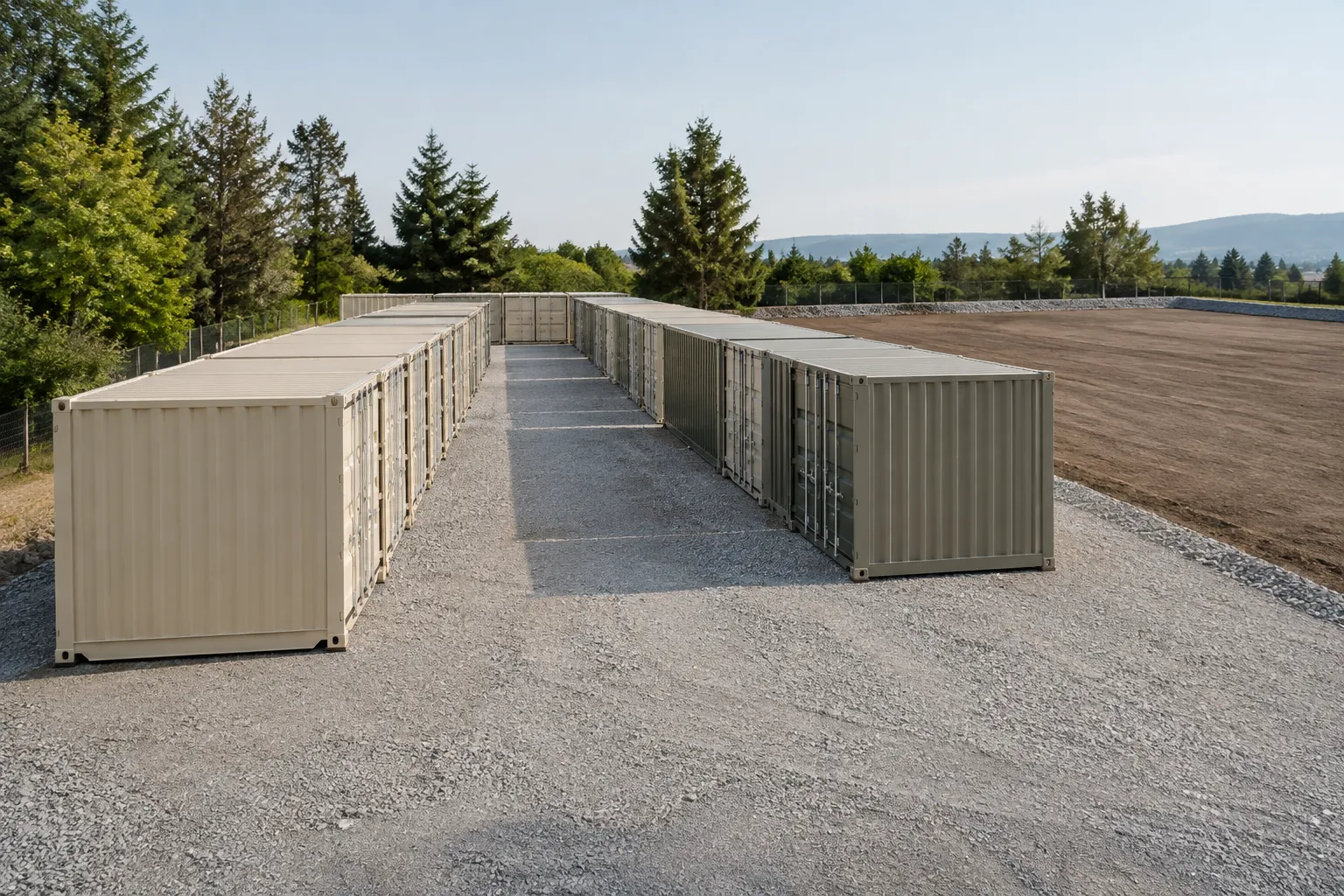
If you plan to buy shipping containers for self storage business operations, order the smallest viable batch that tests your local unit mix without overwhelming your operating budget. An illustrative starting point is eight rentable units—four 10ft and four 20ft—rather than immediately buying 24. That is a worksheet scenario, not a universal recommendation: an established facility with documented unmet demand may justify more, while an unapproved site should order none yet.
The right first order depends on achieved rents, realistic occupancy, installed costs and the cash needed during initial occupancy growth. Lease Lane Containers sells the containers; you operate the customer-facing storage business.
Should You Add Container Units to an Existing Facility or Start a New Yard?
An existing facility can test container demand using inquiry records, move-ins and customers turned away by unit size. Existing gates, software and staffing may reduce incremental expenses, but only if they have spare capacity. Include additional maintenance, insurance and management time rather than treating expansion as cost-free.
A new yard must support its own infrastructure and operating costs. Before selecting quantities, confirm:
- Zoning permits customer-access self-storage, not merely incidental storage.
- Planning officials accept the proposed containers, layout and appearance.
- Fire access, setbacks, drainage, accessible routes and parking fit the site.
- Ground support and crane access work for both the first and later batches.
Our permanent-storage permit guide helps organize the approval questions. If your project includes restrooms, the U.S. Access Board’s toilet-room guidance explains relevant accessibility requirements; it does not determine whether your particular facility must provide restrooms. Confirm that locally.
For a shipping container storage facility expansion, prepare both an incremental-cost model and a fully allocated model. The first supports the purchasing decision; the second checks whether the entire operation remains healthy.
Validate Local Demand Before Ordering
National conditions provide context, not a local occupancy forecast. The Yardi Matrix October 2026 report reports that September advertised self-storage rates fell 1.8% year over year, with monthly declines across all 30 major metros tracked. These are broader self-storage figures—not achieved rents or container-facility performance.
Build a local demand log before committing capital:
- Record nearby facilities’ available sizes, access arrangements and promotional terms.
- Compare outdoor, non-climate-controlled units with similar access—not premium indoor space.
- Track inquiries by requested size, intended move-in date and acceptable monthly rent.
- Separate casual interest from reservations with clearly disclosed terms.
- Record cancellations and move-outs as carefully as new customers.
Achieved rent means what you actually collect for occupied units after concessions and collection losses. Advertised rent is only a starting assumption. An existing operator can calculate achieved rent from its records. A startup should label estimates as unvalidated until customers actually pay.
Do not treat every reservation as a move-in. Use your own conversion history where available, and run a downside scenario where fewer reservations convert. Repeated availability checks are more useful than a single competitor snapshot.
Choose the Initial Unit Mix: Separate Units or Divided Containers
Compare 10ft containers with 20ft containers based on customer demand and monthly contribution, not simply exterior footprint. Nominal container dimensions are not guaranteed rentable interior dimensions.
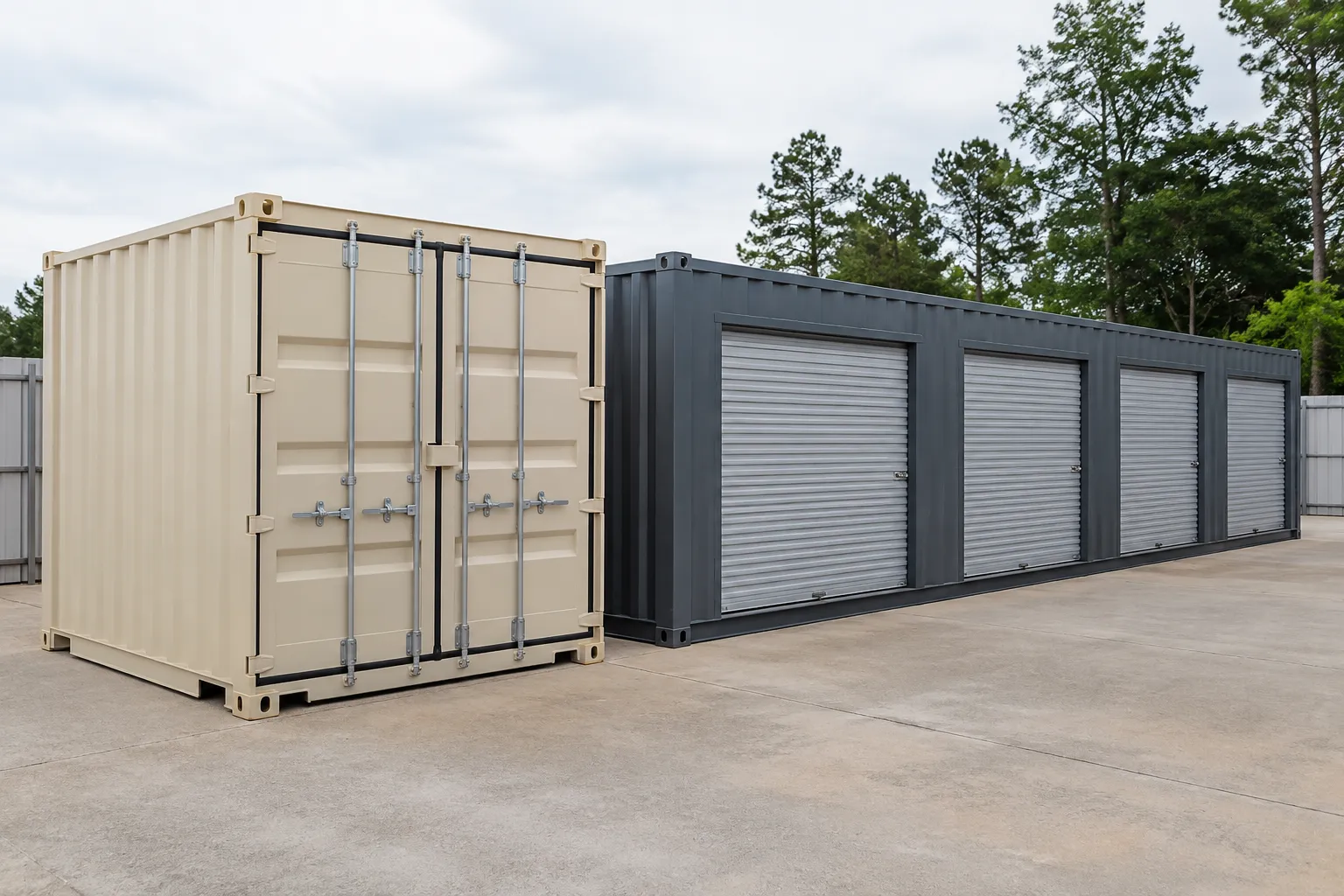
For a separate-unit pilot, useful comparisons include:
- 10ft new double-door containers, currently $2,850, for smaller individual spaces.
- 10ft roll-up storage containers, currently $3,250, when door operation suits the intended customers.
- 20ft used shipping containers, currently $2,395, as a standard-size comparison.
- 20ft new one-trip containers, currently $3,250, when a more consistent appearance matters.
When evaluating 20ft containers for self storage, inspect door effort, threshold height, usable floor area and customer maneuvering space. A container with two entrances is not automatically two independent rental units.
Divided units can increase rentable-door count within one shell. Compare 40ft multi-compartment containers and 40ft seven-bay storage containers within our modified containers.
Before counting bays as revenue-producing units, confirm internal dimensions, full separation, independent locks, door clearances and ventilation in the written specifications. Door count alone does not establish compartment count. Standard storage containers also are not climate-controlled; assess condensation management and disclose appropriate storage limitations to customers.
Compare a Small Pilot Order With a Larger Bulk Purchase
The following worksheet compares eight separate containers with 24. All rent and expense figures are hypothetical operator assumptions, not market evidence, Lease Lane Containers prices or projected returns. Replace them with local achieved rents and written site-work estimates.
| Worksheet input | Eight-unit pilot | 24-unit opening |
|---|---|---|
| Unit mix | Four 10ft, four 20ft | Twelve 10ft, twelve 20ft |
| Assumed achieved monthly rent | $95 / $150 | $95 / $150 |
| Full-occupancy monthly revenue | $980 | $2,940 |
| Base occupancy / vacancy | 75% / 25% | 75% / 25% |
| Revenue at base occupancy | $735 | $2,205 |
| Monthly fixed operating expenses | $450 | $900 |
| Variable expense assumption | 8% of collected rent | 8% of collected rent |
| Monthly operating surplus at base occupancy | $226.20 | $1,128.60 |
| Hypothetical site-work allocation | $8,000 | $18,000 |
| Container acquisition subtotal | Four of each selected product | Twelve of each selected product |
| Installed capital per rentable unit | Total installed capital ÷ 8 | Total installed capital ÷ 24 |
The larger scenario spreads some expenses across more doors. It also needs three times as many occupied units to reach the same occupancy percentage. Six occupied units mean 75% occupancy in the pilot but only 25% in the larger yard.
Searching for bulk shipping containers for sale is sensible once quantities are supported by demand. Do not assume a volume discount, future stock reservation or fixed future pricing unless those terms appear in your written quote. Compare separate batch quotes with a larger purchase before deciding.
Calculate Installed Cost per Rentable Unit
Shipping container self storage startup cost includes considerably more than the steel boxes. Use this equation:
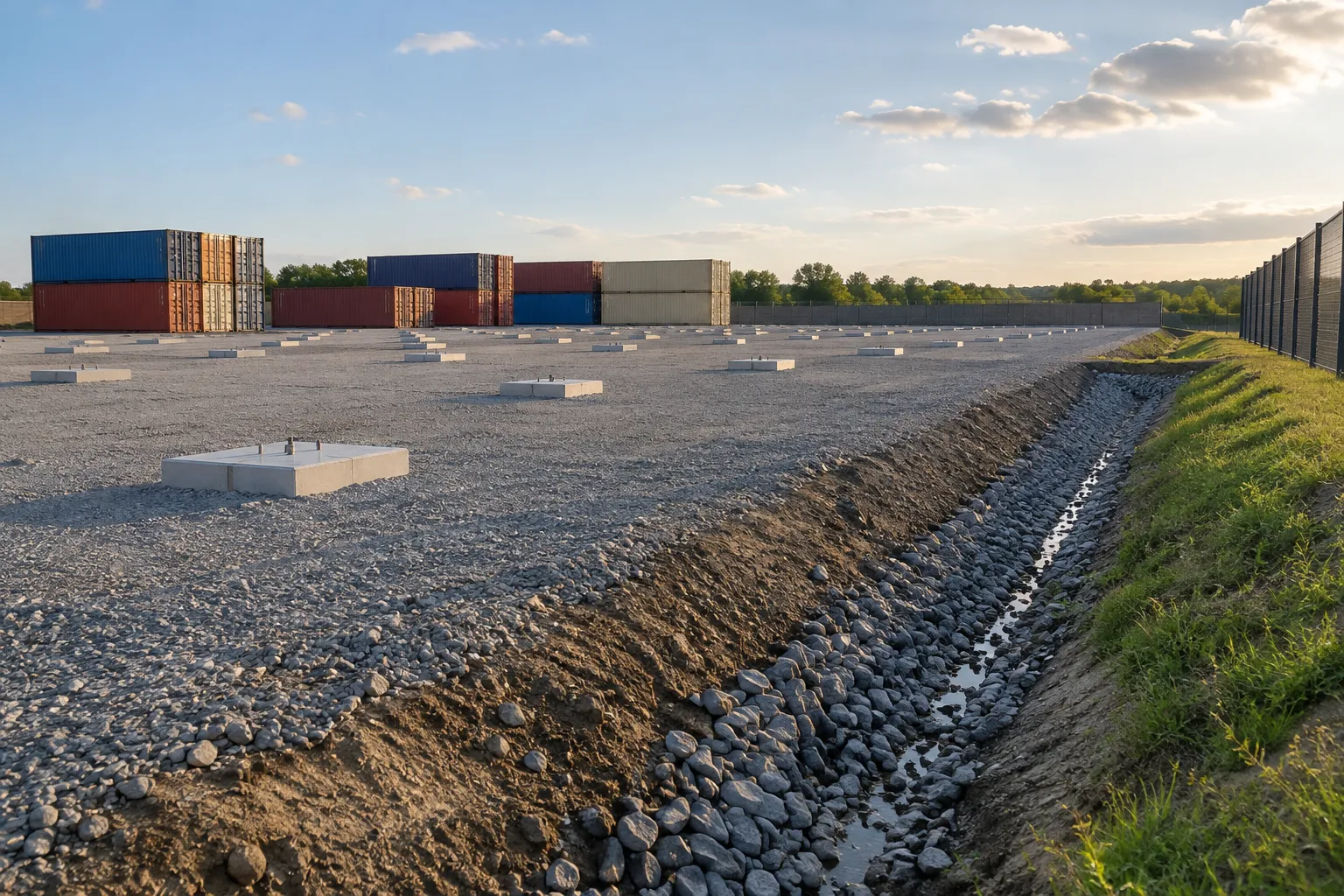
Installed capital = container acquisition + modifications + site preparation + infrastructure + professional fees + applicable site-specific delivery charges + contingency.
For the pilot using the listed new 10ft and used 20ft products, the acquisition worksheet is:
4 × $2,850 + 4 × $2,395.
Add the illustrative $8,000 site-work allowance, then actual amounts for everything else. The allowance is a fictional third-party budgeting input—not a quote for installation. Divide the completed total by eight rentable units. For the 24-unit scenario, use twelve of each product and divide the completed total by 24.
Include surveying, permits, grading, engineered supports where needed, drainage, gates, fencing, lighting, cameras and utilities. Separate one-time infrastructure from work repeated with each batch. Keep land acquisition separate and visible if applicable; do not hide it outside the project return calculation.
Sales tax is included and paid by Lease Lane Containers, so nothing is added at checkout.
Also set aside operating cash for initial vacancies. It is not the same as installed capital. Our delivered container cost guide and buyer’s guide help structure the acquisition comparison.
A divided shell should be evaluated per independently rentable compartment, with shared infrastructure allocated consistently. Lower acquisition cost per door is not useful if undersized bays remain empty.
Buy Shipping Containers for Self Storage Business: Model Break-Even
For a mixed-size facility, calculate revenue potential by size first:
Full-occupancy revenue = sum of each unit count × its achieved monthly rent.
With proportional occupancy across sizes:
Operating break-even occupancy = monthly fixed operating expenses ÷ [full-occupancy revenue × (1 − variable expense rate)].
Using the worksheet:
- Pilot: $450 ÷ ($980 × 0.92) = 49.9%.
- Larger opening: $900 ÷ ($2,940 × 0.92) = 33.3%.
These percentages cover only the modeled operating expenses. They do not repay your purchase investment, include income taxes or establish an acceptable return. Include property expenses, insurance, software, marketing, repairs and paid management labor in the appropriate expense lines.
Test downside conditions and capital recovery
Reduce achieved rents by 10% and occupancy to 50%. Monthly operating surplus falls to negative $44.28 for the pilot and $317.16 for the larger scenario. Those results assume the listed fixed expenses remain unchanged.
For a chosen capital-recovery period, add a monthly recovery target:
Capital-inclusive target occupancy = [fixed monthly expenses + installed capital ÷ recovery months] ÷ [full-occupancy revenue × (1 − variable expense rate)].
This is a simple cash-recovery screen, not a discounted investment valuation. If the result exceeds 100%, the selected rents, costs and recovery period do not work together.
For a more accurate container storage business break even model, calculate occupied units separately by size. Empty 20ft units cannot be offset mathematically by assuming the same occupancy as fully rented 10ft units. Track unavailable units separately from ordinary vacancy, too.
Set Expansion Triggers Based on Rental Results
When you buy shipping containers for self storage business growth, approve the next batch against written thresholds rather than optimism. Illustrative triggers might include:
- At least 85% occupancy for three consecutive monthly reporting periods.
- Achieved rents meeting the underwriting assumption without deeper concessions.
- A verified waiting list for the specific size being reordered.
- Positive operating cash flow after realistic labor and maintenance allowances.
- Sufficient cash remaining for both installation and downside operating needs.
These are example decision rules, not industry benchmarks. A small pilot needs judgment: seven occupied units out of eight equal 87.5%, but one move-out changes occupancy materially.
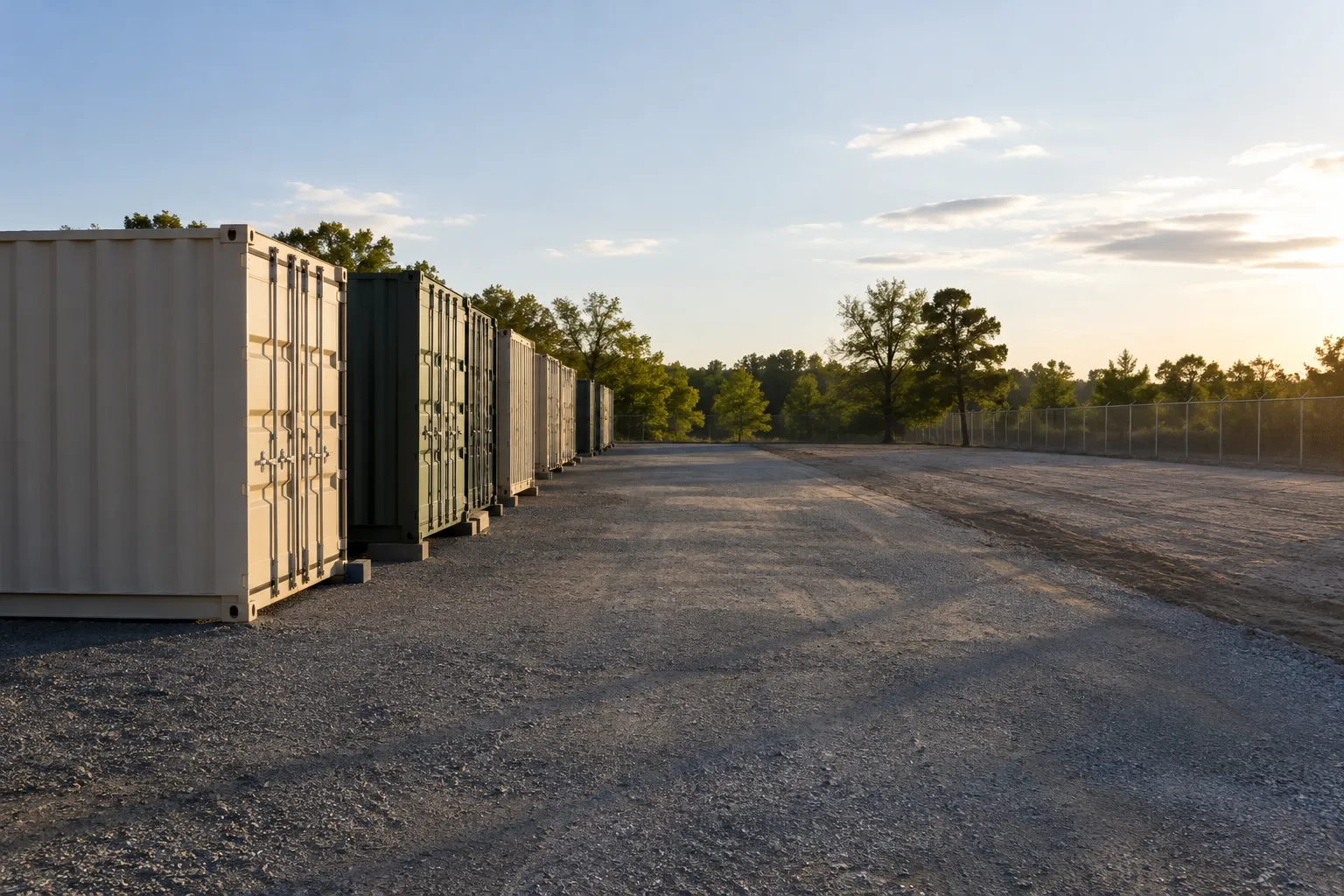
Track net move-ins—move-ins minus move-outs—alongside occupancy. If smaller units fill while larger units stall, change the next mix rather than reproducing the original order. Preserve clear access to future placement areas so expansion does not require moving occupied containers.
Request a Phased Multi-Unit Quote
Ask for a first-batch quote and a separately identified expansion option. Include:
- Site ZIP code, approval status, layout and delivery access photographs.
- Container quantities, grades, sizes, door types and usable-space requirements.
- For divided units, compartment dimensions, partitions, locks and ventilation.
- Delivery batches, crane placement locations and site-readiness responsibilities.
- Itemized inclusions, exclusions, quote validity and any proposed volume terms.
- Inspection, acceptance, defect-reporting and return terms.
Every unit ships from our Raleigh, NC yard and is delivered by our own trucks, trusted freight carriers or a vetted partner delivery agency, depending on your location.
Standard Delivery is free on all orders delivered within the contiguous United States (Lower 48). Containers, homes and offices are offloaded and placed by crane. Remote or non-standard sites and locations outside the Lower 48 are quoted in writing before you pay.
For in-stock products other than container homes, handling is 1–3 business days. Standard transit is 3–7 business days, 4–10 business days in total. All times start once full payment has been received and count business days only (Monday – Friday, excluding U.S. federal holidays). Enter your ZIP code on any product page to see your estimated arrival dates. Our driver calls you one day before delivery to confirm the exact time. Review our shipping policy when planning batches.
Units pass our manual light test before dispatch. 30-Day Structural Guarantee: if a structural defect or leak is found within 30 days of delivery, we'll provide a mobile repair, an exchange or a full refund, as set out in our Refund & Returns Policy.
Returns have a 30-day window. Defective or incorrect units cost $0 to return; change-of-mind returns carry a 15% restocking fee, and the customer arranges return freight. Review the Refund & Returns Policy before ordering.
Start with demand-supported capacity, then expand the sizes customers actually choose. Browse the relevant containers above or request a phased multi-unit quote with your unit mix, site plan and first-batch quantity.
What "fully furnished" means: when one of our container homes is described as fully furnished, it means built-in amenities only: interior finishes and any built-in cabinetry, kitchen or bathroom fit-out, electrical and plumbing that are listed in this home's specifications. Loose furniture and appliances (for example beds, sofas, tables, refrigerators and microwaves) are not included unless listed in your written quote.
Frequently asked questions
There is no universal minimum. Compare a small pilot with a larger opening using verified demand, installed capital and operating expenses. An eight-unit pilot can test two sizes, but it may not support a standalone yard’s fixed costs. Confirm approvals first, then choose a batch your downside cash-flow model can support.
The better size is the one that produces reliable collected rent relative to its installed cost and operating burden. Smaller spaces may attract customers with lower total monthly budgets; larger spaces may meet different local needs. Test demand separately, confirm usable interior dimensions and compare monthly contribution rather than assuming more square footage produces better returns.
Yes, an appropriately divided container can provide independently accessible storage compartments. Confirm full separation, individual locks, usable dimensions, ventilation and approved modifications before counting each compartment as a rentable unit. Multiple doors alone do not prove independent compartments. Include the surrounding customer-access area when comparing a divided container with separate units.
Divide fixed monthly operating expenses by full-occupancy monthly revenue multiplied by one minus the variable expense rate. Use achieved rents after concessions and collection losses. This calculates operating break-even only. To test capital recovery, add a monthly recovery target to fixed expenses, and model different occupancy levels for each unit size.
No. A larger purchase may spread site infrastructure across more rentable units, but it also increases capital committed before demand is proven. Any volume pricing must be confirmed in writing. Compare installed cost per rentable unit, expected vacancies and operating cash needs—not just the acquisition subtotal—and request separate first-batch and expansion quotes.
Sources & further reading
- Yardi Matrix — Matrix Self Storage National Report, October 2026
- Verisk CargoNet Reports Persistent Labor Day Cargo Theft Exposure Across U.S. Freight Networks
- National Retail Federation — NRF Forecasts 2026 Holiday Sales Growth as Consumers Remain Resilient
- U.S. Access Board — Chapter 6: Toilet Rooms
- NOAA — El Nino Looms Large Over U.S. Winter Outlook
Talk to our Raleigh team
Ready to find the right container?
Get a written quote, check availability or ask about delivery to your site. Lease Lane Containers LLC answers every enquiry personally.
- Call us+1 (984) 219-9882
- Emailsales@leaselanecontainers.llc
- Visit5832 Lease Ln, Ste B, Raleigh, NC 27617
- Business hoursMon - Fri: 9:00 AM - 5:00 PM · Sat - Sun: Closed (ET)