Delivery & Site Preparation
Shipping Container Forklift Ramp for Sale: Capacity & Fit
Match a container ramp to your loaded equipment—not just the doorway. Use this worksheet to check threshold height, wheel loads, slope, securement and the complete delivered quote.
9 min readBy the Lease Lane Containers team
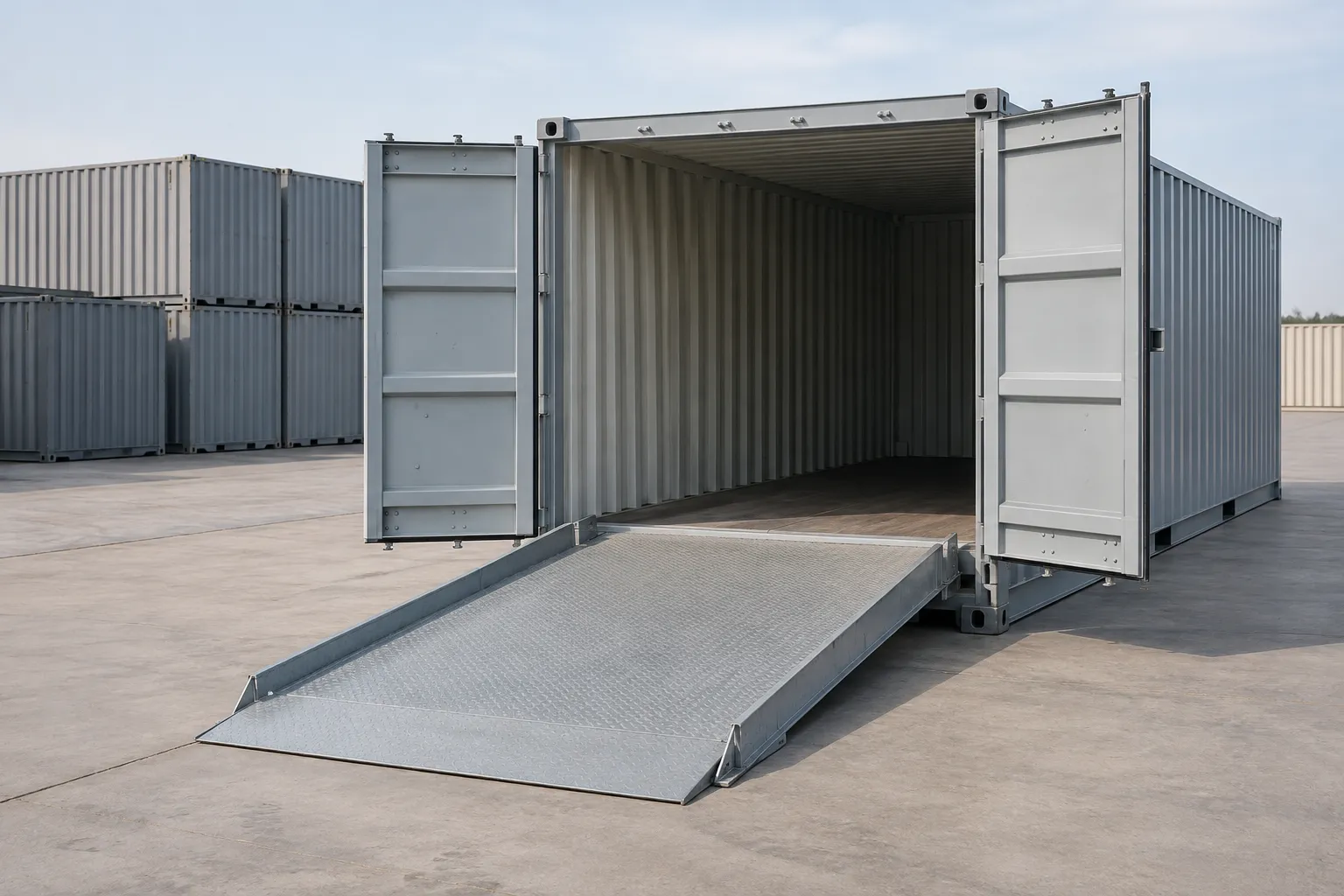
A shipping container forklift ramp for sale is suitable only when its documented capacity, working height, clear width and transitions match your loaded equipment and installed container. A steel ramp is not automatically forklift-rated, and a forklift-compatible ramp may still be unsuitable for a pallet jack.
Lease Lane Containers lists a removable steel shipping container loading ramp in stock at $299. However, the available listing information does not establish its load rating, dimensions or forklift approval. Request those specifications and written application confirmation before ordering it for powered equipment. Use the worksheet below to build that request.
Which shipping container forklift ramp for sale fits your equipment?
Start with the equipment that will actually cross the threshold. Container length alone cannot determine ramp suitability.
| Access equipment | Main selection issue | Evidence to request |
|---|---|---|
| Counterbalanced forklift | Combined operating weight and concentrated wheel loads | Manufacturer approval for the loaded truck, axle loads and working height |
| Powered pallet jack | Small load wheels, underbody clearance and braking | Approved slope, transition profile and wheel-load compatibility |
| Manual pallet jack | Pulling force, control on slopes and small wheels | Explicit approval for manual equipment and the proposed rise |
| Hand truck or cart | Wheel diameter, load control and operator footing | Capacity, traction surface and suitable transitions |
A forklift ramp for ground level container access still climbs a raised floor. “Ground level” describes placement, not a flush doorway.
A short shipping container threshold ramp may bridge a modest step but create a slope or sharp crest that a pallet jack cannot negotiate. Do not substitute a hand-truck plate or trailer ramp without documented approval for the application.
Browse container accessories for candidate equipment, then select by verified specifications rather than appearance. If several machines will use the entrance, submit every model; the heaviest machine is not necessarily the one with the most restrictive clearance.
What equipment and load information should you send?
Send photographs of the equipment identification plate and the manufacturer's operating specifications, plus a written description of normal and maximum loads. A forklift's lifting capacity is not its own weight or the total load crossing the ramp.
Include:
- Equipment make, model and configuration, including attachments.
- Actual operating weight, with battery or fuel and operator as applicable.
- Maximum cargo weight, including pallet, packaging and handling fixtures.
- Loaded axle or wheel reactions, where available from the equipment manufacturer.
- Tire type, wheel dimensions, wheelbase and outside wheel-track width.
- Ground clearance, lowered mast height and load dimensions.
- Expected crossings per shift and whether travel occurs in both directions.
- Outdoor conditions, including rain, debris, freezing surfaces and drainage.
Identify whether people walk alongside the machine. A ramp sized for tires alone does not establish a safe pedestrian route.
If the equipment details are incomplete, mark them unconfirmed rather than estimating from a similar truck. The container buying guide can help organize the container purchase, but equipment-specific limits must come from its manufacturer or qualified representative.
How to measure the installed threshold and approach space
Measure the entrance after the container is installed on its final supports. If it has not been placed, submit planned elevations for preliminary review and make final ramp selection conditional on verified measurements.
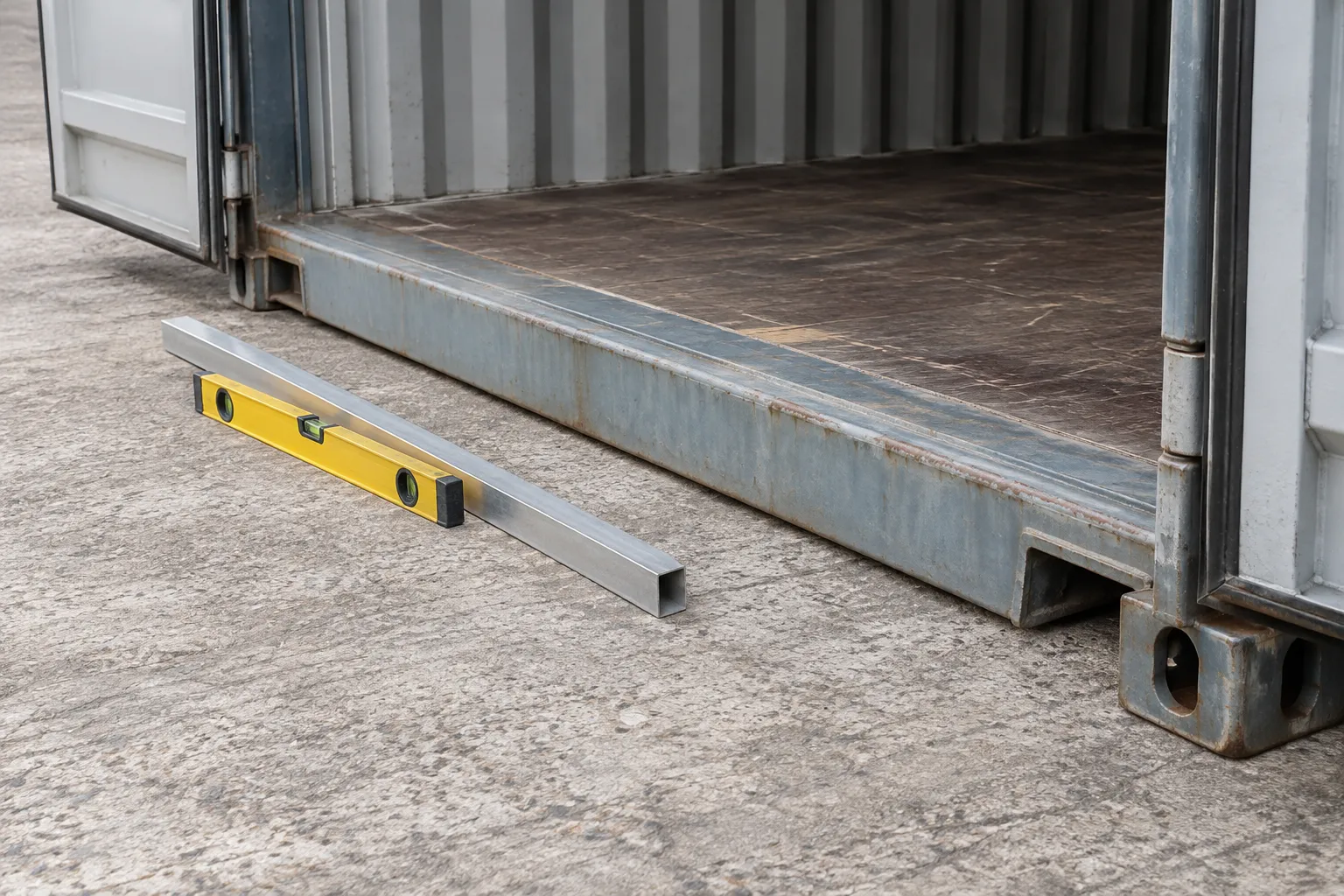
- Record the rise. Measure vertically from the ramp's intended ground-bearing surface to the interior floor and upper bearing location. Record any raised sill separately.
- Check both sides. Measure left and right elevations to reveal cross-slope or uneven support.
- Measure the opening. Record usable doorway width and height with doors secured in their operating position.
- Document the bearing surface. Photograph the sill, floor edge and structural surfaces where the ramp lip would rest.
- Measure the approach. Record clear straight-line distance from the threshold to the nearest obstruction, plus the space required to line up the loaded machine.
- Document the ground. Identify pavement, gravel, joints, drains, depressions and changes in slope.
Use a straightedge and level to distinguish vertical rise from sloping ground. A diagonal tape measurement is not the threshold height.
Include a side-view photograph and a dimensioned sketch showing proposed ramp position, doorway and obstructions. Avoid choosing a ramp from a generic container floor-height estimate.
Our backyard site checklist covers broader placement constraints. If the container needs elevation, the flood-zone storage planning guide is relevant because additional support height changes the ramp problem substantially.
How to compare ramp capacity with fully loaded equipment
Where the installation is a dockboard application, OSHA 1910.26(a) requires support for the maximum intended load. Use that requirement to frame your purchasing questions—not as evidence that a particular product is approved.
Begin with this calculation:
Maximum crossing weight = equipment operating weight + operator if not already included + attachments not already included + cargo and pallet.
For illustration, a truck weighing 9,000 pounds, an operator weighing 200 pounds and a 3,000-pound palletized load create a 12,200-pound crossing load, assuming attachments are already included. That calculation is a starting point, not a ramp recommendation.
Ask the ramp manufacturer to evaluate concentrated wheel loads, axle spacing, loading cycles and dynamic effects at the proposed working height. A uniformly distributed load rating cannot simply be treated as a forklift rating. Do not invent a universal capacity multiplier or assume that matching the total weight is sufficient.
Container ramp weight capacity also does not establish the container floor's capacity. The sill, floor, cross-members, supports and underlying ground must accommodate the intended loading. STRUCTURE Magazine's discussion of shipping container design explains why container structural behavior and load paths matter; it is not approval for a particular forklift installation.
For used units, review the used-container inspection checklist and request a floor assessment specific to your equipment. Container grade descriptions in our container information guide are not substitutes for concentrated-load approval.
Which width, slope and transition details need approval?
Ask for the ramp's clear usable width, not just overall width. Curbs, handles and connection hardware can reduce the travel surface. The opening must accommodate tires, the machine body and the load with manufacturer-approved clearance.
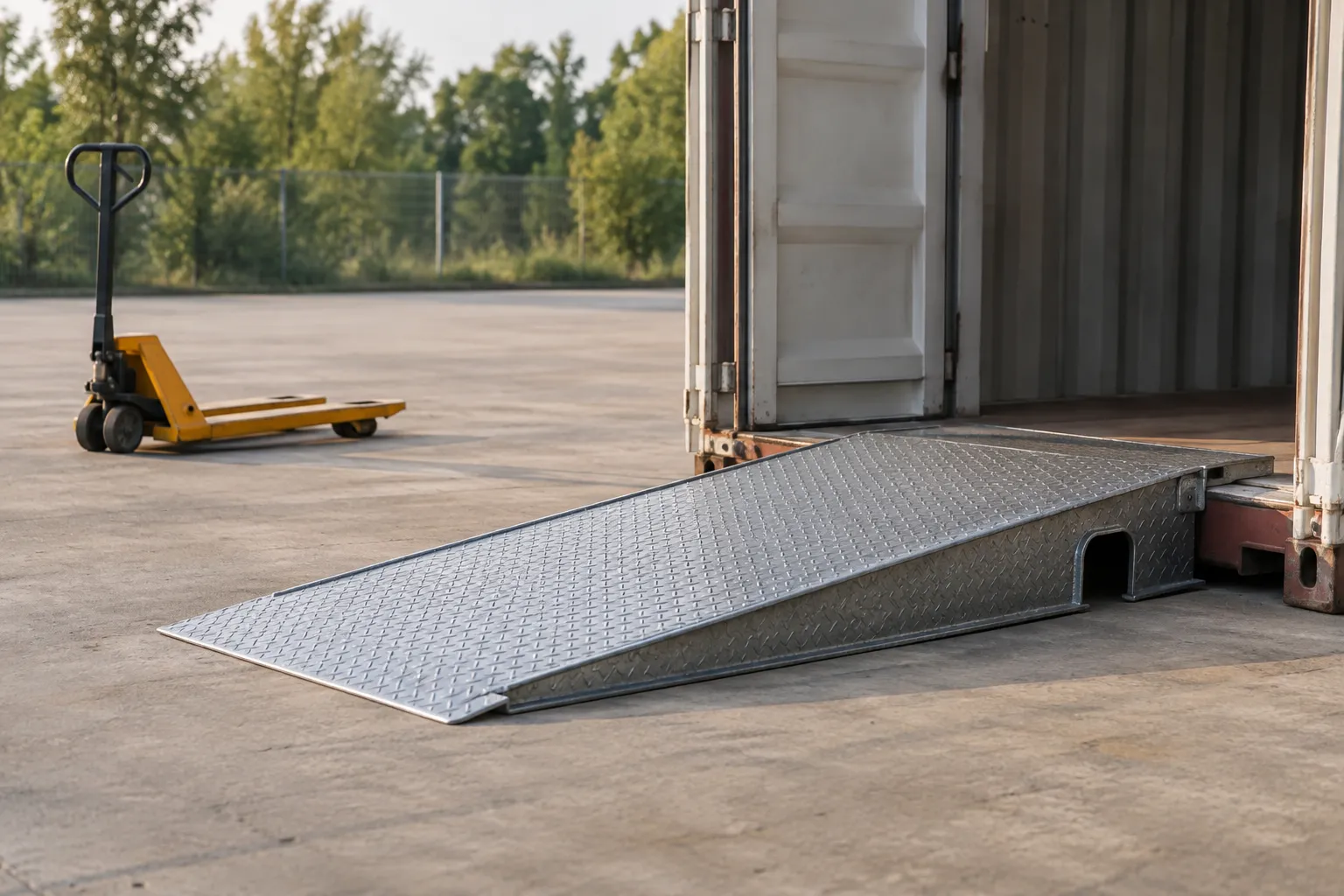
Slope is calculated as vertical rise divided by horizontal run, multiplied by 100. For example, a 6-inch rise over a 60-inch horizontal run is a 10% slope. This is geometry only—not a recommended operating slope. Ramp deck length and horizontal run are not interchangeable.
Obtain written confirmation of:
- Permitted loaded operating slope for the specific equipment.
- Ramp minimum and maximum working heights.
- Bottom transition suitability for wheels, forks and underbody clearance.
- Top transition and breakover clearance at the container sill.
- Required upper lip overlap and lower bearing support.
- Doorway and overhead clearance throughout the crossing.
A published gradeability figure alone may not establish safe loaded operation, braking or stability. Follow the equipment manufacturer's operating limits and travel-direction instructions.
Small pallet-jack wheels can catch on lips or gaps that larger forklift tires cross. An overly abrupt crest can also leave the jack's underside touching the ramp while its wheels lose useful contact. Send the transition drawing to the equipment manufacturer rather than testing compatibility with a loaded machine.
A longer ramp can reduce slope but consumes more approach space. If the approved configuration does not fit, change the layout or handling method—not the equipment limits.
What securement, edge protection and handling features matter?
For applicable dockboards, OSHA 1910.26 addresses more than capacity. Portable dockboards must be secured against movement using anchoring devices or equipment. Where that is infeasible, the employer must ensure sufficient contact to prevent movement from a safe position.
The same standard requires dockboards placed in service on or after January 17, 2017, to prevent equipment from running off the edge, unless the employer demonstrates there is no run-off hazard. It also requires handholds or other means for safe handling of portable dockboards. Apply these provisions with your site's safety lead; do not assume that a stationary container makes every dockboard provision irrelevant.
Request a manufacturer-defined arrangement for:
- Positive securement and compatible attachment points.
- Edge protection appropriate to the application.
- Traction suited to the tires and expected surface conditions.
- Safe repositioning using approved handles, lifting points or fork pockets.
- Storage that prevents unintended movement or damage.
- Inspection criteria for welds, deformation, wear and connections.
Do not improvise securement with unrelated hardware or drill the container without approval. Container twist locks, for example, are not automatically ramp anchors.
Our fold-away container door stay is listed in stock and can be considered for door management after fit confirmation. It is not a ramp restraint. Likewise, the in-stock motion-sensor solar floodlight may supplement visibility, but its presence does not establish adequate workplace lighting.
What belongs in the container ramp delivered price?
Request an itemized container ramp delivered price showing the ramp model, approved configuration, connection hardware, freight arrangements and unloading responsibilities. Separate an included component from an optional item or unresolved requirement.
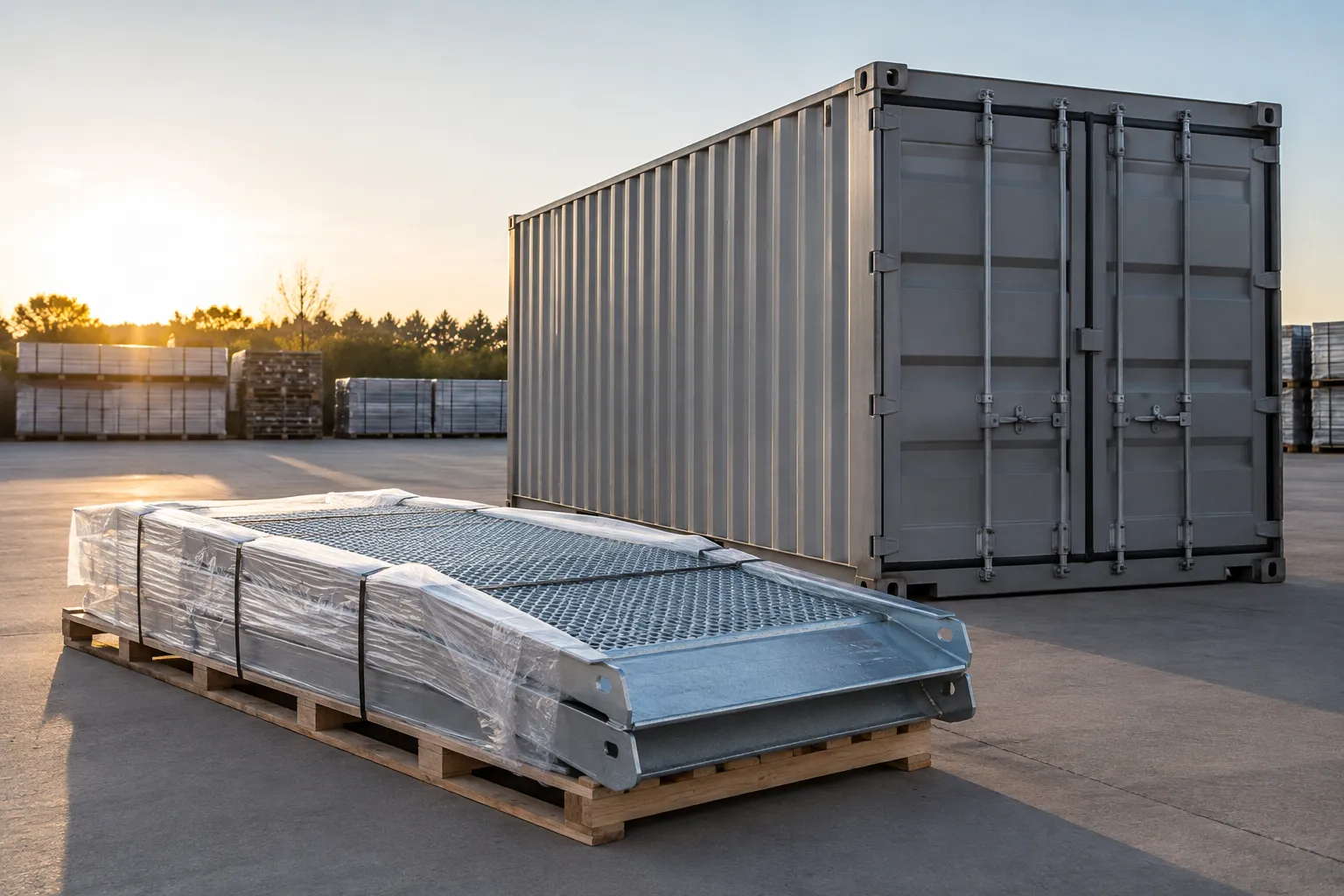
Standard Delivery is free on all orders delivered within the contiguous United States (Lower 48). Remote or non-standard sites and locations outside the Lower 48 are quoted in writing before you pay. Containers, homes and offices are offloaded and placed by crane. Trailers are delivered by road tow, and accessories ship by standard freight.
Do not assume the container's crane service includes accessory installation or that a ramp arrives attached to the container. Have the quote identify accessory unloading arrangements and who will install and check the ramp.
Every unit ships from our Raleigh, NC yard and is delivered by our own trucks, trusted freight carriers or a vetted partner delivery agency, depending on your location.
For in-stock products other than container homes, handling is 1–3 business days. Standard transit is 3–7 business days, or 4–10 business days in total. All times start once full payment has been received and count business days only, Monday–Friday, excluding U.S. federal holidays. Expedited isn't offered on accessories.
Enter your ZIP code on any product page to see your estimated arrival dates. Our driver calls you one day before delivery to confirm the exact time. Review the shipping policy alongside the written quote.
Sales tax is included and paid by Lease Lane Containers, so nothing is added at checkout.
Request a matched container-and-ramp quote using this checklist
Copy these fields into your request for a shipping container forklift ramp for sale. Attach equipment specifications, photographs and a dimensioned entrance sketch.
- Container: selected product, installed or planned location, door configuration and floor condition.
- Equipment: make/model, operating weight, attachments, tire type and wheelbase.
- Maximum load: cargo plus pallet, operator allowance and loaded axle/wheel data.
- Entrance: left/right rise, sill profile, clear opening and proposed lip bearing.
- Approach: usable horizontal run, alignment space, ground material and cross-slope.
- Approval required: capacity basis, working-height range, width, transitions and securement.
- Accessories: door stays, lighting and manufacturer-required connection hardware.
- Commercial details: quantities, ZIP code, availability, freight, unloading and installation exclusions.
For a compact storage purchase, start with the 20ft used shipping container at $2,395. For a larger footprint, compare the 40ft standard-height used container at $3,525. Where access from either end matters, consider the 20ft tunnel container. None of these selections establishes forklift floor compatibility without review.
Ask for a matched package listing the chosen container, the removable steel ramp only if approved for your application, necessary securement and optional door-management or lighting accessories. The supplied catalog lists these accessories in stock; reconfirm current availability and obtain missing technical documentation before committing.
The right purchase is a documented match, not simply a ramp that reaches the doorway. Browse 20ft containers or 40ft containers, then request a container-and-accessories quote using your completed measurements.
What "fully furnished" means: when one of our container homes is described as fully furnished, it means built-in amenities only: interior finishes and any built-in cabinetry, kitchen or bathroom fit-out, electrical and plumbing that are listed in this home's specifications. Loose furniture and appliances (for example beds, sofas, tables, refrigerators and microwaves) are not included unless listed in your written quote.
Frequently asked questions
The removable steel loading ramp is listed in stock, but the supplied product information does not establish forklift suitability, capacity or dimensions. Request the manufacturer's rating and written confirmation for your loaded equipment, wheel loads, installed threshold and securement arrangement. Do not operate a forklift on it based only on its steel construction or product name.
Start with the combined weight of the equipment, operator, attachments and maximum palletized cargo, avoiding double-counting items already included in operating weight. Then have the manufacturer evaluate axle loads, concentrated wheel loads, working height and operating conditions. A total-weight calculation alone does not establish suitability, and the container floor needs a separate assessment.
Not necessarily. Pallet jacks have small load wheels and limited underbody clearance, making bottom lips, gaps and the top transition particularly important. Manual pallet jacks also introduce control and pulling-force concerns on slopes. Obtain explicit approval for the exact jack, loaded weight and proposed ramp profile rather than assuming a forklift-rated ramp will work.
Measure vertically from the intended ground-bearing surface to the interior floor and upper ramp-bearing location after final container placement. Record the sill separately, measure both sides and document ground slope. Include clear doorway dimensions, available straight approach distance and photographs. If placement is still planned, treat the measurements as preliminary until verified on site.
The removable steel loading ramp is $299. Standard Delivery is free on all orders delivered within the contiguous United States (Lower 48), and accessories ship by standard freight. Remote or non-standard sites and locations outside the Lower 48 are quoted in writing before you pay. Confirm accessory unloading and any required installation hardware in your quote.
Sources & further reading
Talk to our Raleigh team
Ready to find the right container?
Get a written quote, check availability or ask about delivery to your site. Lease Lane Containers LLC answers every enquiry personally.
- Call us+1 (984) 219-9882
- Emailsales@leaselanecontainers.llc
- Visit5832 Lease Ln, Ste B, Raleigh, NC 27617
- Business hoursMon - Fri: 9:00 AM - 5:00 PM · Sat - Sun: Closed (ET)